The Writing Off Social Podcast recently had me on as a guest, and I wanted to share that episode with you. The hosts are dedicated to helping Christian authors get off social media. It’s an important mission because so many authors have suffered under the false promise that social media allows them to sell their books for free. It doesn’t work, and it can even become addictive and destructive.
In this episode, we start by talking about social media and then transition into AI tools for authors. I think both parts of the conversation will be helpful for you.

AI Tools for Authors: A Conversation with Thomas Umstattd, Jr.
Sandy: Writing Off Social is the podcast for female Christian writers who want to grow their audience without relying on social media.
So let’s talk about the elephant in the room, or should I say the robot in the room: AI.
Will AI replace me or help me?
Sandy: If you’re a writer, you’ve probably wondered, “Is AI here to replace me, or can it actually help me? Should I ignore it, embrace it, or ask it to make me a cup of coffee while I finish this chapter?”
Technology keeps changing how we write, publish, and think about productivity. But your voice, perspective, and stories can’t be automated. This week, our guest, Thomas Umstattd Jr., unpacks what AI means for authors, how to use it wisely, and why the future of writing is still very much human.
Sandy: Thomas, can you tell everyone who you are and what you do?
Thomas: I host several podcasts. The longest-running is Novel Marketing, which is all about how to sell more books. We started in 2013, which is about a million years ago in internet time. I also host The Christian Publishing Show, which focuses on writing craft, how to write a better book, and how the publishing process works.
Recently, we launched a new show that’s primarily on YouTube but also available as a podcast called Author Update. It’s a weekly news show covering the latest in publishing and marketing. Novel Marketing focuses on timeless strategies that don’t change, while Author Update covers timely issues, like the latest drama with Audible royalties, and breaks down what it means for authors.
Mary K.: I’ve been thoroughly enjoying Author Update. I love the industry insights and the dynamic between you and Jonathan.
What is your relationship with social media?
Mary K.: We love to ask our guests about their relationship with social media. Do you consider YouTube social media? How are you using these platforms personally and professionally?
Thomas: My complicated relationship with social media goes way back. I was one of the very first advertisers on Facebook. My first ads were called “Campus Flyers” because Facebook was only for college students at the time, and I was a college student.
I helped one of the first political campaigns that used a Facebook-first approach. But I started souring on Facebook in the mid-2010s because EdgeRank, Facebook’s AI, started influencing what people saw in ways that were hostile to authors. It became clear that engagement on Facebook had no measurable impact on book sales.
When I was a marketing director for a publishing company, I saw the numbers. Spending time there didn’t build a platform. It was a massive time suck. Advertising on Facebook could still work for some authors, but trying to grow organically was a waste. Instagram and TikTok are even worse.
I actually use social media a bit more now because of Author Update. I’m on X (formerly Twitter) a lot because that’s where news happens first and with the least spin. You can get statements directly from newsmakers, like the FBI director, before the narrative forms. YouTube, cable TV, and podcasts all deliver post-narrative news.
As a news person, I’m trying to get pre-narrative news, and X is the best source for that. For instance, when major world events happen, I can curate lists of intelligence analysts and official accounts to get real-time, unfiltered updates before they’re interpreted by the media.
X even has a non-algorithmic mode, which is rare. Depending on how you define “social media”—whether it’s algorithm-based or not—X can actually function more like an old-school news feed.
Substack, by contrast, has an algorithm mode that’s on by default. On X, you can follow people chronologically or create custom lists. For example, you might create one list for sports updates or one for global events. It also has a “For You” page that’s algorithmic, similar to TikTok or Facebook, but you can choose to avoid that. So in a sense, X feels more like Facebook did in 2012, before it became manipulative.
What’s the difference between using social media and using it as a tool?
Sandy: I love that you’re using social media in a way that serves you rather than drains you. Curating content directly from the source makes sense, especially for your news podcast. I appreciate the distinction between using social media for information versus using it to sell books.
Thomas: The metaphor I like to use is that social media is like a sporting event. The people in the stands are shouting as loud as they can, but just because you are shouting louder than everyone else doesn’t make you famous on social media.

Social media only works for the people on the field. If you’re the quarterback, for instance, social media works for you. The same goes for major brands like Coca-Cola that advertise in the stadium. But regular fans in the crowd can’t get famous on social media. It’s an illusion. Buying a ticket doesn’t make the crowd listen to you.
That’s how social media works for most authors. You can’t expect to shout about your book amongst all the other shouting and get people to listen.
Sandy: It’s an illusion of access. You think you have access to all 5.24 billion people who are on social media.
Thomas: Many of those are AI bots.
Sandy: True. Regardless, you go there and think you have access to billions of people, when in reality, you only have access to a handful. The people who see your content are the ones immediately around you who can actually hear you. That’s it.
Is AI a friend or foe for authors?
Sandy: As if social media isn’t already a divisive topic, let’s add another one for writers. I’m on Substack, and there is a heated debate over whether authors should use AI at all. Do you think AI is a friend or foe? Should authors be using it at all? Can you offer a helpful way for writers to think about AI as we start this conversation?
Thomas: One of the guiding lights for me when it comes to technology is the book of Ecclesiastes, where Solomon says that there’s nothing new under the sun.
I’m old enough to have lived through several technology hype cycles. Every time it’s, “This time it’s different. This is the time that will change everything. This is the end of the world as we know it.” But people forget that humans never change. People still struggle with the same sins, and they have the same hopes and dreams they always have.
With that framework in mind, I see AI as a powerful tool. The question is, how do we approach powerful tools? The answer is that we use them for good.
Guns, knives, and electricity are powerful tools. In the early days of electricity, there was a lot of fear. There was “safe” electricity, which was DC, and “dangerous” electricity, which was AC. Westinghouse had AC. Edison had DC. Edison tried to convince Americans that AC was dangerous by inventing the AC electric chair.
But the name that stuck wasn’t “AC electric chair.” It was just “electric chair.” His attempt to scare people away from Westinghouse and Tesla’s superior technology didn’t work. Electricity is dangerous. An electric current can kill you. Alternating current is more dangerous than direct current, but that doesn’t mean we should reject electricity.
How you use electricity matters.
Is AI good or evil?
Thomas: Nearly all the evil committed in the last 50 years required electricity, but so did all of the good. Electricity powers air conditioning and lights in churches and homes. It makes this conversation possible.
Technology itself is neutral. People often try to make technology morally charged, but that attempt is almost always financially motivated. Edison didn’t care about people dying. He cared about people using his direct current rather than Westinghouse’s alternating current. That’s why he created the electric chair; he wanted to scare people for financial reasons.
Some people in the author world make a lot of money with AI and are trying to push other authors away from using it.
I spoke with an author this week who came up with an idea for a book, wrote it in two days using AI, published it, and it became the number one new release in its category. This author isn’t pushing others away from AI, but there are authors who quietly or anonymously try to discourage its use because it benefits them financially if others don’t adopt it.
It’s like being the only farmer in town with a tractor and convincing all the other farmers that tractors are evil. Eventually, you get to buy up all their fields. Or you might think of it like being the only building in town with electricity and convincing everyone else that electricity is bad so that you get all the business.
Rejecting AI outright is naive. The people who moralize and make it an ethical conversation often can’t articulate the difference between a large language model, machine learning, and an algorithm. Many of them present their moral objections on social networks powered by AI.
Google and Facebook have been using AI for 20 years, but the moral panic has only existed for about a year and a half. AI isn’t new. Large language models, machine learning, and neural networks aren’t particularly new. What’s new is that tech companies in Silicon Valley are slapping the “AI” label on a whole suite of technologies that have been around for a long time. All of these components come together in products like ChatGPT, but many of the underlying parts have existed for decades.
I haven’t heard anyone clearly who objects to AI on an ethical basis explain where the line is. At what point is it okay to use technology? We all use word processors now, but there was a time when teachers checked papers to make sure they were typed on typewriters because word processors were considered cheating. Teachers don’t do that anymore. We laugh at it now, but there was a moral panic about word processors in the 1980s. People said they would rot students’ brains.
That same panic goes back to Aristotle or Socrates, who worried that writing would rot the minds of children who would no longer memorize the Iliad and the Odyssey. He wasn’t wrong.
Sandy: We’re not memorizing books like that.
Thomas: I don’t even have my wife’s cell phone number memorized.
What boundaries should authors set around AI?
Mary K.: AI is a powerful tool we must use for good. It brings to mind the even more primitive technology of fire. To use fire well, you have to keep it contained. We have fireplaces to burn fires in our homes without burning the whole house down. It comes back to boundaries. Do you personally have boundaries around your AI use? Or are there boundaries or considerations you’d recommend to authors when they sit down to write?
Thomas: I love the metaphor of fire because fire, in many ways, seems alive. It’s difficult to create definitions of living things that don’t also include fire. Fire consumes, grows, and moves. We know fire isn’t alive and is a force of destruction, but crafting a definition of life that includes plants and animals but excludes fire is tricky. Most of us can’t do that off the top of our heads.
AI seems alive in some of the same ways that fire seems alive. It’s dangerous in a similar way as well. But figuring out fire as a way of externalizing our digestion was a huge breakthrough for human civilization. Many foods we eat can’t be digested effectively without the aid of fire. Without it, we would be able to eat far fewer foods, and if we ate certain foods without using fire first, many of us would die.

What is the danger of personifying AI?
Thomas: One area where AI gets dangerous is in chat-based interactions. I dislike chatting as the primary interface for AI because the temptation is to personify it.
We stop referring to AI as “it” and start referring to it as “him” or “her.” That pronoun shift changes how we interact with it. It stops being a tool and starts becoming a personality in our minds. I don’t think chatting is bad, but you have to be careful. Personally, I have a very transactional relationship with AI. I use a lot of different AI tools, but I don’t go to AI when I’m lonely or need to talk to someone.
I also don’t go to AI for judgment. AI can’t provide true judgment. I realized this when I started building tools for authors.
One of the first tools I built was a book cover analyzer. I found that AI would always score covers four out of five or eight out of ten because it wanted to be generally positive with a few suggested tweaks. If you get AI’s feedback on something, it’s almost always the “four out of five stars” rating because it can’t offer real judgment. Judgment is a human thing.
Eventually, I was able to build tools that offer a facsimile of judgment. They review a webpage or book cover but don’t truly judge it; they just count elements. For example, I did an episode on the elements a homepage should have. The AI checks whether those elements are present and then gives a score at the bottom. It doesn’t tell you if you did a good job; it tells you if you included the necessary components.
One criterion of a good homepage is third-person pronouns. If you want to rank for “Sandy Cooper,” you need the words “Sandy Cooper” somewhere on the homepage. If it’s all “I” statements like “Welcome to my website” without mentioning your name, it’s bad for SEO. My tool, the Homepage Scanner, checks for that and gives you a point if you’re using third-person pronouns, but it can’t tell you whether your website is ugly.

You can push it off its sycophantic rails, but it’s tricky. Getting it to point out errors takes work. I built tools to help with editing and analyzing structure, and I had to specifically tune them not to flatter people. This is where machine learning and large language models work hand in hand.
Machine learning is how Facebook’s algorithm works. Humans provide the success metric, and the machine programs itself. For Facebook, the metric was “time spent on the platform,” so it optimized itself to become more addictive, like refining cocaine into crack and then fentanyl. Machine learning also drives AI and operates on whether you “thumb up” a message. Sometimes you’re shown two messages and asked which you like better. People always pick the more flattering option because they like to be flattered.
As a result, machine learning inevitably tunes large language models toward flattery. I find that large language models tend to be better when they first come out. As people use them and their weights are tweaked, they get worse and more sycophantic until a new model is released.
It’s easy to say, “I want honest feedback on my writing,” but most of the time, people don’t actually want honesty; they want flattery.
How can writers use AI tools to improve productivity?
Sandy: Can you give us some ideas for how writers can use AI tools to supercharge their productivity?
Thomas: My tools are a great place to start because they do most of the work for you. When people first pull up ChatGPT or another AI, they see a big empty screen with a little text box and type questions into it like it’s Google. If the result isn’t good, they think, “AI is awful.”
It’s like sitting in front of a piano and saying, “Did you know your piano can play the new Taylor Swift song?” It’s true, but most people would rather hear Taylor Swift sing it than play it themselves. A piano includes all songs ever written and all songs that could be written, but playing the piano requires skill and practice.
The Patron Toolbox I’ve built is like records or CDs that have a specific song on them. They do just one thing, and they do it for authors. It’s a suite of tools, and I’m constantly adding more.
How does your pitch generator tool work?
For example, writing back-cover copy is difficult for many authors. I built tools to do that. You simply answer questions about your book, and it generates a blurb you can tweak. This came from a talk I gave at the Novel Marketing Conference about pitching. I realized I could build an AI tool to do the final step for you.
For nonfiction, you answer a set of questions, and it generates a blurb. I also created one where you upload your book and it generates the blurb from the manuscript. Authors loved these tools because writing blurbs is painful.
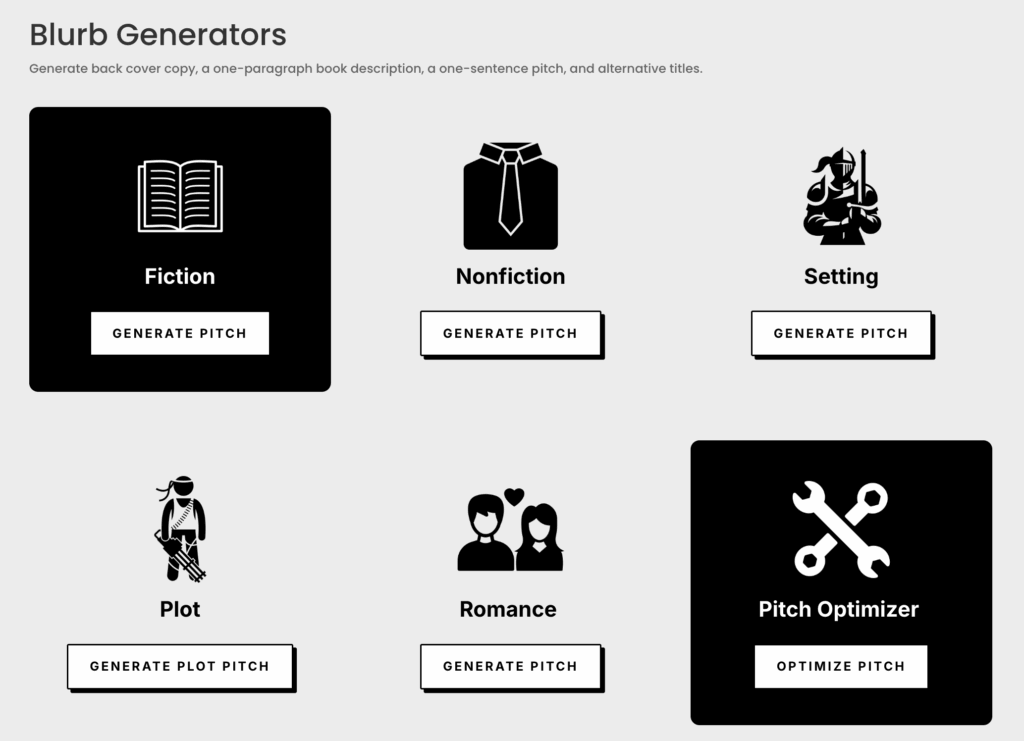
I built tools to take the tasks authors enjoy least and make them easy. I created tools for chapter summaries and writing a synopsis because authors hate those tasks, too.
Get access to all 50+ tools in the Novel Marketing Patron Toolbox.
Some models are better at some things than others. They all have strengths and weaknesses. With these tools, I can use whatever model is best at the time. If Elon Musk releases a great model, I switch to it. When Anthropic comes out with a new one, I switch back.
Sandy: When you talk about the different models and which ones are best for certain things, are you actually using ChatGPT or Grok to create your tool?
Thomas: Yes.
Sandy: That is fascinating.
Thomas: My tools run on Grok 4, GPT-5, and Claude with version 3.7 or 4, depending on which performs better. I also use both Gemini 2.5 Flash and Gemini 2.5 Pro. One tool uses DeepSeek and another uses Meta, but those are only for checking what Meta and DeepSeek know about your book.
I built a tool that asks the AI what it knows about your book without letting it search the internet. If you go to ChatGPT and ask what it knows about a specific book, it will usually do a quick Google search to refresh its memory. That’s not helpful because readers are now going to AI for book recommendations, and if the AI’s own knowledge base isn’t familiar with your book, it won’t recommend it. My AI Knowledge Checkers checks the internal knowledge of one model only. Since it costs me extra to give AI access to Google, I don’t pay for that access with this particular tool. What would normally be a bug becomes a feature because it’s siloed. You’re asking the model directly what it knows.
For writing tools, most of the blurb generators use Claude because it’s best at writing. But when I need a large context window for tools that have to analyze an entire book, Gemini performs best. It has the biggest context window and vectorizes the least.
My Character Compendium tool lists every character in your book, creates a short bio for each, and generates voice persona notes for audiobook narrators. You can use it to keep character consistency across a series or to help narrators capture voices accurately. For example, “This character is Scottish” or “This woman is stern and sharp-tongued.” It builds that automatically from your writing, and you can tweak it from there.
Tools like that work best with Gemini. Tools that require deeper thinking and analysis tend to run best on Grok. I’ve found ChatGPT isn’t the best at much; it’s often the second best at everything, which is why a lot of people use it. It’s reliable and accessible but rarely the top performer for a specific task.
I do use ChatGPT for the Book Cover Designer tool. It’s great for brainstorming or creating a temporary cover, especially for reader magnets. You answer a few questions, press a button, wait five minutes, and get a cover. It’s become my most popular tool, even though it’s also the most expensive because image generation uses a lot of tokens. Still, people love it.
That tool uses ChatGPT because it’s the best at combining text and images naturally. Many AI image engines struggle with text; they misspell words because they use a system called Stable Diffusion, which isn’t fluent in English. ChatGPT’s image model doesn’t use Stable Diffusion. It uses a completely different approach that integrates text much better. I know I’m nerding out here, but that’s why it works so well.

Mary K.: No, it’s great. I just wish we could meet you where you are technically. It’s genius to harness the power of these tools and build something specifically for authors. I would never in a million years know how to create something like that. What you’ve done doesn’t just take the dread out of tasks we don’t enjoy; it removes barriers that were keeping us from doing them at all.
I’ve used several of your tools, though not the image generator yet. I’ll save that for a special occasion since it’s the most expensive. But I’ve loved the others. They’re so helpful. Listening to you and watching how you use AI has taught me that I can use AI to leapfrog several steps ahead. It helps me get past barriers that used to slow me down. In thirty minutes, I can accomplish what used to take me two hours. I’m really grateful for what you’ve created.
You call it your Patron Toolbox because you have to become a patron or purchase a course to access the tools, correct?
Thomas: Basically, yes. Some courses have tools embedded, but if you want access to the full suite of the Patron Toolbox, you can become a patron. It started as one or two tools, and now we have more than 70.
What’s one simple step writers can take to start using AI?
Mary K.: If someone wants to dip her toe into AI, what’s one simple step she can take to start using it in her writing?
Thomas: I have one tool that your audience will especially appreciate because it helps prove that social media doesn’t work. It’s my newest tool, called the Royalty Analyzer. It helps you analyze your royalty statements. You upload the Excel file from your KDP dashboard report, and then you upload a log of your marketing activities, which hopefully you’re keeping separately.
I’m doing an episode about this soon, titled “Double Your Book Sales with One Simple Trick.” The trick is tracking what you do. What’s the best way to improve your eating? Track what you eat. The best way to improve your workout? Track your workouts. What gets measured gets managed. Just keeping a log of your book promotion activities will change how you approach marketing, even without analysis.
Once you have that log, paste it into the Royalty Analyzer. You can still do social media if you think Sandy and Mary are crazy. Just log it. Write down the date and description of each campaign, then upload it. The Royalty Analyzer will examine your sales across eBooks, paperbacks, hardbacks, and Kindle Unlimited page reads, harmonize all the numbers, and tell you what worked and what didn’t. You’ll know whether that podcast interview on August 14 moved your numbers up or down. That way, you can have an informed conversation with your publisher about what’s really working.
If you’re still writing your book, I think the Blurb Generator is the best place to start. I’m a big believer in writing your back-cover copy first. Many authors spend months writing a book only to realize it isn’t what readers wanted.

I made that mistake myself.
I’m not primarily an author, but I once wrote a blog post about dating and courtship that went viral, and everyone told me to turn it into a book. The post critiqued the book I Kissed Dating Goodbye, and by the time my book came out, Joshua Harris had already recanted. He even invited me to be part of his documentary. The problem was that my book was still half critique and only half practical advice, which was the “how to” part that everyone actually wanted. It was a missed opportunity, and it happens to authors all the time.
The easiest way to avoid that is to do what Hollywood calls “creating the poster first.” Before you write the book, write the blurb and create a temporary cover. The Patron Toolbox has tools to help you do both. Then take those outputs and ask your friends, “Would you buy this book? How could I make this blurb more appealing?” You’ll get valuable feedback before you write a single chapter.
That helps ensure that when you do write, you’ll hit your target.
For chat-based tools, I recommend experimenting playfully at first to get comfortable. They’re also great for research. Google has become less useful lately because it’s hard to find reliable results, but Grok and Perplexity are amazing. They give better answers, often with citations, and can answer the question behind your question.
For example, if I want to know how many American troops are stationed in each European country, the old way was to search each country individually. Now I can ask Grok for a list of European countries with U.S. troop presence and troop numbers, and it will compile the data, cite its sources, and generate a chart in minutes. That kind of capability dramatically speeds up nonfiction research and lets you verify the information yourself.
But there’s also a more existential question for authors—especially nonfiction authors—that we should probably talk about: will we even need nonfiction books in the future?
Will we even need nonfiction books in the future?
Thomas: Nonfiction books are already less popular than they used to be because of Google. The kinds of questions people used to look up in an encyclopedia or dictionary, they now ask Google. I collect every edition of What to Expect When You’re Expecting because it’s a snapshot of how publishing changes. I have the first four editions, and I think they’re on their sixth now.
We bought a copy when we were expecting, like most couples. But as a husband in publishing, I noticed my wife was not really reading the book. She was using the What to Expect app.
What to Expect kept up with technology. First, it was a book with references. Then it was a book plus a website with thousands of additional articles. In the 2010s, they released an app with a community. You could join a group of moms all due the same month. Everyone with an October 2026 due date, for example, could share first-trimester experiences, see premature births, and grieve miscarriages together. The book still helped you discover answers to questions you did not yet know to ask, but if you already had the question well articulated, posting it to the community was faster.
What they have not done yet—and I am watching for it—is build a chatbot trained on those 10,000 medical articles and on the book’s content. That is the next natural evolution for nonfiction: turn the book into a chatbot.
Why build a chatbot from your own content?
Thomas: I have already done this with my podcasts. I have 12 years of Novel Marketing and about five years of The Christian Publishing Show. Many episodes became blog posts. I built a chatbot called AI Thomas that answers book marketing questions with my answers, based on what I have actually said in previous episodes. Unlike asking a generic model, AI Thomas gives the Thomas Umstattd answer.
There is nothing stopping me from doing the same for you. I could create an AI Sandy Cooper trained on Writing Off Social. If you write nonfiction and are a subject matter expert, creating a chatbot is a strong way to add value now. It is still a bit tricky and costs money to set up, but in five years it will likely be easier and cheaper.
The personality and decision-making matter. If someone asks about social media generally, they will get a pro–social media answer. If they ask the Sandy Cooper bot, they will get a very different answer. That human preference is important. Whether readers get it through a nonfiction book or a chatbot trained on that book, both are valuable. Long-form exploration still matters, but you should control the chatbot based on your writings. If you do not build it, someone else will, and they can tune it their way.
Connect with Sandy Cooper and Mary Kay Tiller at Writing Off Social
Website: Writing Off Social
Related Episodes
- The Author’s Guide to AI with Joanna Penn
- What does ChatGPT Actually Know About Your Book?
- How to Create Sales Optimized Book Pages for Your Author Website
- AI Optimization for Authors
- Your Author Toolbox: Time-Saving Tools for Busy Authors
- Book Promotion in 2025: How AI Gives Authors More Time to Write