I recently interviewed Steve Laube, of the Steve Laube Literary Agency, about his new book Sacred Margins. In that webinar interview, Steve also answered questions from authors about writing, publishing, and finding a literary agent.
Thomas: Tell us about your new book.
Steve: It officially releases next Tuesday, though Amazon decided to start shipping early, which messes up our launch plans. But next Tuesday is the official day. It’s called Sacred Margins: On the Spiritual Life of a Writer (affiliate link). I’ve been teaching writers about the topic for decades. It’s one of those things that writers all understand, and yet it never quite affected me the same way until I felt the necessity of formulating the concepts into written form.
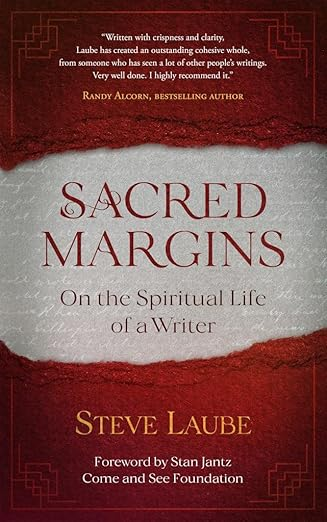
I started writing in a journal on an airplane about a year ago, and the next thing I knew, I had 20,000 to 30,000 words ready to go on various topics. It’s a topic that is not often published or discussed, and I think that’s a failure, particularly in our field where we’re trying to change the world through our words. You need a solid foundation to do that.
Writers universally struggle with the same questions. They just don’t realize they’re not alone. So I’ve tried to express those struggles with waiting, imposter syndrome, and the challenges of success and failure. Both are very difficult, by the way. I rolled those topics into a consumable form that gives authors an opportunity to explore this from a scriptural and biblical standpoint.
Thomas: For some authors, the lack of success is God’s mercy. Success is a real challenge of character.
Steve: Just a couple of days ago, I was talking with a writer who was struggling with what to do with their writing. I paused and said, “You’re coming at this from a very utilitarian mindset. You believe your writing needs to have a tangible purpose.” Then I got quiet and said, “To be honest with you, the answer to your question is not what you can do with your work. It’s whether or not you’re obedient to do it in the first place.”
There was just shock on the other end. The writer said, “I’ve never thought of that before.”
I said, “You’ve been writing for five years, and you’ve never been published. In the world’s eyes, that means you failed. In my eyes, that means you’ve been faithful. Whether or not it turns into something with commercial value, that’s a different question entirely. The question is whether you are fulfilling the call to write down the thoughts you’ve been given. If they’re brilliant, great. If they turn into a book, great. If they turn into an article, great. If they don’t, guess what? You still have a reader, and he happens to be divine, and he’s been asking for a long time, ‘When are you going to put those words down on paper?’”
That’s one of the core messages in this book, and yet for this particular writer, it had never crossed their mind that they felt the need to have it have a purpose, meaning publication. For many writers, publication shouldn’t necessarily be the goal. Not everything you write needs to be published.
Thomas: In fact, most of what you write probably should not be published.
One of my Ten Commandments of Book Marketing is “Thou shalt not publish your first book first.” What I mean is that your first book may be good, but you don’t have eyes to see whether it’s good or not until after you’ve written your second book. I have yet to meet anyone who followed that commandment and regretted it. I have met many people who broke it and regretted it.
Writers need to recognize that the writing itself is a beneficial act. There’s an old saying that the carpenter doesn’t just build the house, the house builds the carpenter. That’s true in writing, and particularly for novelists.
Your first novel is more about learning how to write a novel and proving to yourself that you can, than it is about creating something commercially viable. The more you write, the more you realize writing is just a thing you can do, and it goes a lot faster. Your first novel might take 20 years. Your second might take two.
I interview people on the Christian Publishing Show who are writing several books a year. Jerry Jenkins goes to sleep, wakes up, and by noon, he’s written another book. Not quite that fast, but it took him a while to get there. He started writing newspapers, then books, then more books. His first hundred books shaped him. The carpenter was built by the house.
Platform vs. Craft: Where should fiction writers invest their time?
Thomas: Kelsey asks, “A ton of emphasis is put on platform for new authors, but when it comes to fiction novels, to what extent does this matter? With finite resources of time and money, how do craft versus platform balance on the scale of where best to invest?”
Steve: It’s a great question and one that comes up frequently, not just for novelists but across all of publishing. Kelsey actually uses the right answer in her question. It’s a balance. There has to be a balance.
Let’s make sure we identify our terms. We have the indie author who’s publishing on their own. They’re pushing the rock up the hill by themselves, trying to get the eyeballs of readers. That’s called marketing. On the traditional side, the question is “What does the traditional publisher want? What are the magic numbers?”
There aren’t magic numbers. There are magic impressions. The number one thing is your email list. The number of people who have said, “Yes, I want to receive your material.”
That being said, I’ve had an author with 20,000 followers whose book no publisher in the industry wanted. I was so shocked. I almost went to the editors and said, “Don’t you dare tell me it’s platform, because this is the number you keep asking me about.” My guess is that nobody liked the book itself, but they would never say that. They’d say, “We just don’t think the audience is big enough.” I disagree. I think they didn’t like the book. So right there, the answer is both/and.
Thomas: It depends a lot on fiction versus nonfiction. Blogging, podcasting, YouTubing, and public speaking make you a better nonfiction author. If you’ve been battling it out in the arena of ideas on Substack for five years and learned how to write the kind of article that gets shares and comments, you are building the muscle that goes straight into writing a good nonfiction chapter.
That does not transfer to fiction.
I may love your analysis on Roman history or your take on the news, but I couldn’t care less about your novel, even if I really like you, because the skills are so different.
Your platform is more important for nonfiction and shapes you more. For fiction, you’re judged much more by the quality of the writing itself.
With nonfiction, the writing can be serviceable, and the book can still be wildly successful. Nobody says What to Expect When You’re Expecting is a beautifully written book. It’s fine, it’s serviceable, but that’s not why it’s successful. It’s successful because it answers the reader’s question.
Steve: Very often that’s true, and yet the platform still factors in. Let’s imagine two novels in front of a publication board. Both are equally great ideas, and both are debut novelists.
One of those people has a very interactive social media presence. They’re well-known in the ACFW community. They’ve been nurtured by other authors and have connectivity. Maybe they’ve found a nonfiction angle on their fiction topic and talk about it in the marketplace. I think of Tracy Higley, who wrote books on the Seven Wonders of the Ancient World and created nonfiction material on those historical places that built interest in her fiction.
The other person is just a great writer. By day, they’re an excellent gardener and have a hundred clients who love them. But they have no website. They can’t even be Googled.
Which one is the publisher going to pick when they decide where to put their money? All things being equal, that’s where platform comes in.
We want to know “What do you bring to the table? Give us a reason to say yes to this project.”
I just got a copy of this year’s Pulitzer Prize-winning novel and started reading it, and thought, “Why did this win?” Then I realized the entire novel is one sentence. There’s no period in the book until the last page. He ends paragraphs with commas. It’s so different, and it’s this weird supernatural, historical, magical realism, science fiction story, and it wins the Pulitzer Prize. You’re sitting there thinking, “Okay. That’s unique.” Did he have a platform before? I really don’t know. But now he does, because he won a Pulitzer Prize.
Thomas: Part of it is also being faithful in the little things. Some people don’t want to be famous, and that kind of person really struggles as an author. They’re often torpedoing their own success. As soon as things start to go well, they take actions either consciously or subconsciously to prevent success.
If somebody is already Googleable, if they’re already a good steward of whatever small amount of notoriety they already have, it gives the publisher more confidence that they’re not that “I just want to stay in the background” kind of person. If you do want to stay in the background, there’s a wonderful profession that pays better than writer, and it’s called editor. Your name doesn’t go on the book, but you still get paid.
If you’re writing fiction and going indie and don’t want to bother with platform, you can just pay for ads. Many authors profitably advertise their fiction without doing big-M marketing. They just buy ads. The way they think about it is that it costs them a dollar to buy a reader, and they make $1.25 per reader, so if they buy $1,000 worth of readers every month, they can make $250.
I’ve interviewed authors who have scaled that all the way up. For instance, Connor Boyack, who bought $10 million worth of ads and made $13 million in revenue. That’s definitely the outlier and not the norm. Plus, he didn’t do that until he was already a well-established brand.
How do you build a platform when no one knows you yet?
Thomas: Alyssa asks, “For someone who has never published anything, how are we supposed to have anyone pay attention to us? It feels like a cycle of not getting published unless there’s a platform, but who would give my platform time of day without something to read?”
There’s been a big change in the last two years. Social media as we knew it no longer exists. Meta’s winning argument to get their antitrust case dismissed was that they are no longer a social network. They’re basically a TikTok competitor. They shared data showing that 90% of everything people do on Facebook and Instagram is watching short videos from strangers. The TikTokification killed social media. The actual social interactions have moved to iMessage group threads, Discord, Signal, and WhatsApp.
Social networks are no longer social networks. They’re just a feed of short videos from strangers.
Steve: Your email list, which you control, is the most important asset you have. These are people who have given you permission to talk to them.
To the person saying, “I don’t have anything like that, how do I get started?” Well, every writer has to start somewhere. You create short pieces that you give away as a lead magnet. Those still work. You start creating good material.
To learn more, check out the following episodes on lead magnets:
- Reader Magnets Are Dead? Why Most Reader Magnets Fail
- How to Grow Your Email List Using Delicious Reader Magnets
- The Strategy Behind Reader Super Magnets
- How to Create a Reader (Lead) Magnet
Substack has started suggesting writers to you based on who you already follow. They’ve realized they may not be the best social network, but they might be the only one left.
There’s also another challenge here. A lot of writers, particularly novelists, tend toward introversion, and if that’s you, I encourage you to build your network by going to writers conferences. You build connections, friendships, and networks one by one. Everyone has to start somewhere.
If you are only in your living room or at your desk, your network is the five friends you have outside your home and the 12 people you know at church, that just doesn’t move anything forward.
Explore the conferences available to you. In a couple weeks I’ll be at the Blue Ridge Conference in North Carolina. Two weeks after that is Write to Publish in Wheaton, Illinois. Then I’ll be at Realm Makers, which is all fantasy and science fiction and is now moving heavily into film. In late August or September is ACFW. Those are just a few of the larger ones.
Thomas: There’s also the Novel Marketing Conference, which sold out last year.

Steve: These are all investments of time and money, but how else are you going to meet other writers? How else are you going to meet people who can share the little tricks you’ve never heard of?
Many people ask me how I came to know so much about this industry. When I began as an editor for Bethany House, I had 11 years as a bookseller behind me. I didn’t even know writers conferences existed. I went to my first one as an editor for a publishing company, and I’m walking around thinking, “These are interesting people. I wonder what a book proposal is.” So, I went to a class on how to write a book proposal and sat in the back and took notes. I went into another class on how to write a novel. I didn’t know how to write a novel, but I was supposed to be editing them. I learned by going to conferences.
The idea of self-education through teaching by others who have already walked the path before works.
Thomas: There’s a saying that you’re the average of your five closest friends. If none of them are published authors, you’re at a disadvantage.
Finding your people also means finding your target reader. The people at writers conferences aren’t going to be statistically meaningful buyers of your book. If you give them a free copy, that book will end up for sale in the used marketplace and will steal an actual sale from you. You need to find your readers, and that starts with finding the single reader, whom I often call Timothy.
What makes an agent pass on a well-written project?
Thomas: Sarah asks, “When you pass on a project that is well-written but not quite ready, what are the most common missing pieces?”
Steve: That is a great question. I want to share something I didn’t originally plan on bringing up, but I think you’ll find it interesting.
I did a statistical analysis of all the submissions I received in a month. In one 30-day period, I received 145 proposals. You can do the math on what that means annually.
Of those, 60% were nonfiction and 40% were fiction. Of the nonfiction, 30 were memoirs, by far the greatest single category. On the fiction side, if you add speculative fiction together, meaning fantasy, science fiction, supernatural, and YA, that was about 32 combined.
None of them, not one, moved past the first stage of my evaluation in that 30-day period. Maybe that means I’m blind to genius, which is possible. I’ve more than once passed on a bestselling author who will lovingly dangle their rejection letter in front of me at an event. Jim Rubart was one of them. My rejection letter said, “I hate your main character. I want him to die.” He had created one of the most unlovable main characters I had ever read. He fixed it and became a bestselling author and a Christy Award Hall of Fame author.
Often, either the topic is not right or the execution just isn’t there. I look for what I’ll call craft triggers. For example, in your novel, do you start every paragraph with a character name, then a verb, then the rest of the paragraph? “Sally jumped…” Next paragraph: “Mark threw…” To my ear, it sounds like a repetitive thump-thump-thump. It’s so easy to fix, but you can’t see it when you’re inside your own writing.
Another big problem for novelists is trying to tell all the backstory in the first chapter.
I remember reading a novel where the author introduced every character at a board meeting. The main character walked into the room, and the author went around the table introducing everybody to me, the reader. I didn’t care who they were. I’m thinking, “Are they important? Do I need to hold on to them all in my head?”
That’s not good storytelling. I know why the author did it. They saw a movie where the camera pans a room and you visually take in a dozen characters at once. Novels don’t work that way.
The tendency for many novelists is to paint the picture you have in your head and try to paint it in mine, and I don’t care. I’m looking for the next stage in the story.
For nonfiction, a lot of times, the idea simply isn’t unique enough.
Thomas: For me, it’s the table of contents.
Steve: Yes. The table of contents is a great giveaway. A good table of contents makes you want to read every chapter. You don’t know which one to read next. I was very intentional about the table of contents for Sacred Margins for exactly that reason.
In my 30-day submission analysis, under Bible study and theology, I received 11 proposals. That included three commentaries on Revelation. I appreciate the enthusiasm, but who is going to buy this? I own approximately 26 commentaries on Revelation by some of the greatest scholars who ever lived. How are you going to compete with that?
Thomas: But Calvin never wrote one. Your collection is incomplete.
Steve: I get that answer too. But you see, that’s the problem. Not understanding the market itself.
Someone can come to me with a devotional, and I’m thinking, “There are six devotionals in that same category coming out right now.” Writers ask, “How am I supposed to figure that out?” Here’s one of the tricks I use. Since there are no more print catalogs from major publishers, I go to Amazon and use the advanced search. I put in a publisher’s name, say Thomas Nelson, then sort by publication date. Future books, some without covers yet, will show up on screen.
I start scrolling. “Oh, look. They have a new Max Lucado book coming out in four months on the exact topic my client is currently writing.” I need to help that client stop writing it, because Max Lucado is a category killer. He’s going to walk in and take all the juice out of that category.
If I get a proposal on stepfamilies, I run it through Faith Words, Tyndale, WaterBrook, Multnomah, Zondervan, Harvest House, and B&H. Have any of them addressed this topic recently? Does this person’s platform support the book idea? Have they been teaching on this topic for ten years, or did they just marry into a stepfamily and are still learning how to be a stepparent? That’s probably not enough credibility.
Those are the factors that affect my decision on whether to accept or reject a book.
How can fiction authors build an email list?
Thomas: Hadassah asks, “What are the best ways for a fiction author to build a strong email list in the Christian publishing industry?”
I have a free course called the Send Your First Email Challenge. It’s a one-week course. At the end of it, you will have gotten your first subscribers and sent your first email. It will take you about 30 minutes a day for five days.
Steve: If Thomas has a free course, it’s worth more than what you’re paying.
Thomas: The follow-on full Author Email Academy is not free, but it will be worth every dime, because this is a key part of making a career out of your efforts.
Steve: Too many people self-publish and sell 10 copies, then contact me to fix it. I can’t.
Someone cold-called my office recently and said they’d published on Amazon last month. What do they want me to do? It’s already published. A new publisher can’t launch it as new.
The only time that changes is if the self-published book sells tens or even hundreds of thousands of copies and generates attention on its own.
Theo of Golden is a perfect example right now. A man self-published very quietly, and people started talking about it. Simon & Schuster bought the rights, and it hit the New York Times bestseller list. Great novel, by the way. Wool by Hugh Howey is another. He started publishing in chapters. It became a phenomenon, and it’s now the Apple TV show Silo. But those are the exceptions.
Most likely, you throw your book into the Amazon void. There are approximately 30,000 new titles uploaded every day.
Thomas: The number of new books published every day has tripled since ChatGPT came out.
Steve: Much of it is AI slop, but still, that’s competition for eyeballs. Do the groundwork ahead of time.
Thomas: Be faithful in the little things. Create a good reader magnet. I have a course called the Five-Year Plan that I did with James Rubart. I’ll give you 90% of it in 30 seconds: every month, read a book on craft and write a short story putting that principle into practice. That’s 80% of the course.
A common mistake I see for novelists creating reader magnets is that they haven’t done much short story work. They make the first or second short story they’ve ever written and make it their reader magnet. It’s not good enough to be that first impression.
Short stories are also a much better way of becoming a better writer because it’s easier to get feedback.
If you ask someone to read your 100,000-word novel, that’s like asking them to come clean your garage. It’s a huge ask, especially if you’re a new author making the same mistake in chapter one that you’re making in chapter twenty. But a 5,000-word story is a much smaller ask.
You also get practice delivering on the ending. This is a real issue. If you learned storytelling in the university system over the last 20 to 30 years, you were taught postmodern storytelling. The postmodern worldview’s natural philosophical and religious culmination is nihilism. Postmodern stories have unsatisfying endings. This is why people get enraged over the finales of TV shows. The writers don’t know how to end the story because they don’t have a redemptive worldview. They have a deconstructive worldview, and once everything’s been deconstructed, all you have is somebody sitting in the rubble.
This is an opportunity for us as Christian authors. We have a Christian worldview, not a postmodern one. We believe in a redemptive Savior who conquers, restores, and redeems. We can have a satisfying ending. It doesn’t have to be a happy ending. A satisfying ending upholds the good, the true, and the beautiful, and upholds the correct moral order. Sometimes that’s done through a proper tragedy, but it’s still satisfying.
Learn to stick the landing in a short story first. Resist the temptation to write the never-ending series. That’s what postmodern storytellers do because they literally don’t know how to end it.
Steve: Nonfiction has the same problem. Many times, you start reading a nonfiction book and just quit because it stops saying anything of worth and runs out of steam.
I was very intentional about how I ended Sacred Margins. The final chapter is called “The Darkness Can Be Pierced.” This whole struggle we have as writers, this constant battle where you’re not quite sure whether you’re fighting yourself or fighting demonic forces, the question is, how do you end something with a takeaway that makes the reader go, “I need to read this again. There was something I must have missed.”
The classic nonfiction works sustain the argument and leave you wanting more from authors like J.I. Packer or Max Lucado. There are times you read Max Lucado, and you have to stop and just appreciate what you’ve read. Or take someone with more literary flair, like Frederick Buechner. You’re winding along trying to follow his literary weaving, and then suddenly something lands, and you have to stop reading because what you just read is like a pop in the nose and makes your eyes water.
Thomas: Delivering on your promise is your brand. Everyone thinks brand is a logo. Once you realize that brand is just the modern word for reputation, it becomes clearer. Reputation is built on making promises and delivering on them. People expect your next book to be as good as your last, if not better. Do not break that trust.
What makes a good comparable title?
Thomas: Emily asks, “What makes a comparable title a good comparison? How do you recommend finding comparable titles?”
Steve: Nonfiction is a little simpler because it’s usually topic-related. But please, don’t name the bestsellers from 35 or 40 years ago. They’re irrelevant as comps. Yes, they’re still selling, but that isn’t your competition. Your competition is the writer sitting next to you at the writers conference. Try to limit your comps to the last five years if you can.
With fiction, here’s where people fail dramatically. They love C.S. Lewis and use him as a comp. Rather than saying, “My novel is better than Francine Rivers,” you’re better off saying, “My book is for fans of Francine Rivers.” You’re not comparing your writing to theirs. You’re comparing your genre to theirs. That tells the publisher which box to put it in. If you’re a fan of Francine Rivers, you’re going to like Thomas Umstattd’s next novel. Now you’ve given the publisher a hook to hang the book on.
In nonfiction, it’s about figuring out where your book goes on the shelf. What’s going to come up in “customers also bought?”
Comparisons help with positioning. How are you going to position your book against the competition?
Thomas: Some of the best character development in film is the line in The Princess Bride when Vizzini is trying to demonstrate how smart he is. “Plato? Aristotle? Morons!” It demonstrates this man thinks he’s brilliant, but in reality, he’s an idiot. When you say, “Francine Rivers is a terrible author, and my book is so much better,” you look and sound like Vizzini.
Steve: Even if you say it respectfully, you’re still not comparing yourself properly. Voracious readers, and they are the ones who float this entire industry, especially in fiction, are always looking for the next read, but they have their favorites. So if you like David Baldacci or Jack Carr, what’s going to come up in the recommendations? That’s your positioning, and that’s the nature of comparison.
For the Christian writer, Amazon is a terrible place to find your comps. If you’re within the Christian market, use ChristianBook.com. They will only show you books currently in print and selling. Amazon shows you every book ever published in the history of mankind.
Thomas: And what Amazon shows you is different from what it shows me. Every page is personalized.
If you want a clean data source, I would buy the K-lytics.com (affiliate link) report for your genre. It only looks at the Kindle market, which is actually the photo negative of ChristianBook.com. Christianbook.com looks only at the physical book market and doesn’t sell ebooks. K-lytics looks only at the ebook market. The two together are like looking out of both eyes.
What are editors looking for in terms of social media platform?
Thomas: Morgan Tarpley Smith asks, “For fiction, what are editors looking for in terms of online platform? Do they care about certain follower counts on social media?”
Social media numbers are not a good metric. Engagement is better, but if you can’t convince a social media follower to join your email list, you’re not going to be able to convince them to buy your book.
Steve: I recently wrote a blog post titled Five Questions Your Book Proposal Must Answer, and one of those questions was about platform.
Numbers are one thing, but you can buy numbers. What they’re actually looking to see is the nature of the interaction and the quality of the online presence.
But if I can’t Google you and find you, you don’t exist. That’s a hard thing for authors to understand. You might say, “I don’t have the money for a website.” There are ways of doing it that are almost no cost at all. Put it on a Christmas list. There are ways to get around some of these issues.
It sounds impossible to get published. Is it?
Steve: After listening to Thomas and me, especially me, you may think it sounds like it’s impossible to get published.
Thomas: The harbinger of grim reality strikes again.
Steve: I do tell the truth. I tell the facts. But that doesn’t mean there’s no hope. It means you have to work at it. If you didn’t have to work at it, it would be called play. This is work. This is a business. This is a calling. We’re trying to make a difference in this world.
Our competition isn’t each other. Our competition is a fallen world that is really good at getting people’s attention. The devil is really good at this business, and he never sleeps. So get really good at your craft. Work at it. Figure it out. You’re not going to figure it out by Friday. This is going to take time, and those who take the time and invest in it will see results. They are God’s results. They’re not ours. If we try to take success or failure upon ourselves, we will drive ourselves into anxiety.
Writers are usually very emotional people. They feel deeply because they’re passionate either about their topic or their story. They feel things in a way that someone who doesn’t write cannot. You’re trying to express those feelings in words and communicate them through these little scratchy letters on a page. That’s an impossible task, but through God’s economy, you can make that difference.
In the last 30 days, our agency did contracts for 22 new books. So don’t tell me you can’t get published. We’re doing it in our tiny little agency. It’s happening every single day. While it seems overwhelming, it is not impossible.
Thomas: It’s also important to resist an entitlement mindset. I see it most often in authors who were previously successful in some other career. They have money, and they think, “I’m a successful person, so I should be able to become a successful author fairly easily.” That’s very disrespectful to the craft of writing.
It’s like saying, “I was a very successful attorney, so I’m going to go into plumbing. It’s just a blue-collar job. How hard can it be?” You’re going to start from scratch because you don’t know anything about plumbing. You need to have at least as much respect for the craft of writing as a plumber has for plumbing. It takes years to become a master plumber. You don’t just go to plumbing school and come out with a master plumber certificate.
Also, resist the gnostic trend among some course creators who promise that they have the secret sauce and everyone’s been hiding it from you. There’s no secret knowledge. The secret is that it’s much harder than you think it is.
Steve: It’s the old joke. A writer is on the operating table about to go under, and the brain surgeon looks at him and says, “What do you do for a living?” He says, “I’m a writer.” “Oh really?” “Yeah.” “I’m gonna write someday.” And then the writer looks back up at the doctor and says, “Yeah, I’m gonna be a brain surgeon someday, too.”
Everyone can write, just like everyone can speak, but there are very different levels of how that is effectively communicated.
Where is the line on violence, language, and sexuality in Christian fiction?
Steve: I want to address the question on where to draw the line on violence and sexuality in fiction. If you’re writing for the general market, there is no line. We know that. You can’t even trust what’s on the shelves in middle-grade novels anymore.
In the clean fiction market, and it doesn’t even have to be necessarily Christian for this matter, the question is who draws the line.
I could say there’s a particular word that in my house is absolutely off limits. But in Thomas’ house, maybe it’s said every day. So who’s right? That word has fallen into our television culture, our movie culture, our everyday conversation culture. And some people will say, “Well, if you can’t write that into your story, it’s not real. All Christian fiction is vapid and unrealistic.”
If that’s your thought, you haven’t read the right novelists. Anyone who says that about Christian fiction hasn’t read enough. I have read some that are really dark and brilliantly present evil, violence, and moral complexity. You just don’t see the blood splatter or the gratuitous detail. That’s not even necessary in movie scripts, really.
And on language, to say you have to use explicit words to be realistic says you’re not creative enough. You can actually make someone sound like they’re cursing up a storm worse than the most unrepentant sailor on a navy vessel and never have to use a single profane word. I used an example from a Douglas Wilson novel in my book on fiction. He wrote something along the lines of: “The man dropped a bucket of curse words on a living room floor and spent the next half hour kicking them around the room.” I know exactly what he’s saying. I can hear it in my head, but I don’t have to read it. A pastor-author wrote a book full of curse words, but none of them are on the page. That’s clever.
Thomas: It’s trickier with violence because it’s somewhat cultural. Americans intuitively know how New England is different from the Deep South, and how the Deep South is different from the Left Coast. But fewer Americans are familiar with the differences between, say, Tidewater and Greater Appalachia. One of the biggest differences between these cultural regions is how people react to depictions of sex and language. It’s not just a Christian versus secular issue.
You can learn more about the cultural differences in America in my episode titled How to Write for American Readers: An Author’s Guide to America’s Regional Cultures.
Steve: Even movie ratings have granular rules about this. You take the worst four-letter word we all know. If it’s used as a noun, it can appear in a PG-13. Used as a verb, it gets an R., and it can only be used once in a PG-13. I read that years ago in an article about how to affect your film rating during the scripting process, and I just went, “Are you kidding me?”
That word will not show up in any book I represent, and if it appeared in a book from a Christian publisher, I would ask that publisher what in the world they were thinking.
We have been wrestling with these questions ever since I entered this industry in 1981, when the Christian fiction section in my bookstore was six feet wide, and all the books were face out because that was all that would fit. We had Grace Livingston Hill, Joyce Landorf, and Jeanette Oke. We had very few options. Now we have an entire industry, and these questions of language, violence, and sensuality versus sexuality are still with us.
How can authors stay current with trends when they don’t have time to read every book in their genre?
Thomas: Hadassah asks, “What are the best places for authors to keep up with trends and the market in the Christian publishing industry when you don’t have time to read every new book in your genre?”
I host the Novel Marketing Podcast and a new news show called Author Update.
Author Update is a weekly live show with four segments. The first is publishing news. We follow the big publishers, openings, closings, and what’s going on with Amazon and Barnes and Noble. The second is AI and how it’s impacting publishing. The third is Author Alerts, which are quick-hit headlines. The fourth is a zoom-out segment called Zeitgeist, where we talk about broader cultural trends. Things that you miss if you’re only looking at daily headlines. We do that one last, so if you don’t want to watch it, you don’t have to. But it’s turned out to be the most popular segment, and a big chunk of our audience waits specifically for that one. It’s live at 4:00 PM Central on Fridays, and replays and clips are available at Author Update.
Steve: Another good source is Jane Friedman. You do have to pay for her newsletter, but I have paid for it for years, and she is one of the premier watchers of the general and indie markets. This morning’s newsletter had a segment about the decline in the middle-grade reading market. I had not seen some of the stats she pulled, and she laid it all out.
Thomas: I read that exact article, and I’m already prepping an Author Update segment on it. Her analysis missed one of the biggest causes of that malaise, though, which is that Americans aren’t having children the way they used to. We had a significant drop in the birth rate about ten years ago, and that’s now hitting the middle grade market. In another ten years, it’s going to hit universities. Where universities are closing is very regional, because where Americans are having children is not evenly distributed.
How many of the proposals you receive are ready for publication?
Thomas: How many of those 300 proposals sitting in an agent’s inbox are ready for publication, and how do you make sure yours is one of them?
Steve: Part of it is whether the project is commercially viable. Is there something here that I can use to convince a major publisher to invest significant resources?
I was talking recently with an executive at one of the publishing houses. He mentioned the number of books they were releasing and then followed up by saying the strain on his staff is overwhelming them. In editorial, the production line, developmental editing, line editing, copy editing, proofreading, typesetting, and then the marketing department, he said they’re just doing too many books.
I said to him, “Whatever you do, do not say the words ‘We’re only going to publish bestsellers,’ because I will laugh at you with derision. I have heard that statement for 40 years.”
Thomas: They all say they’re going to publish fewer and better books. Every publishing house brings in a new CEO, who says, “Fewer, better books.” Then they slowly publish more and more until they’re doing too many books. They fire the CEO and bring in the next one who says, “Fewer, better books,” and the cycle repeats.
Steve: Part of it is that every book generates revenue, and revenue generates cash flow, and one of them might be a breakout hit that nobody saw coming.
How do you find the right literary agent?
Steve: Interview them. Don’t take the first agent who says you’re pretty. Some of them may not be very good at what they do, and they’re desperate.
I’ll tell you a true story. I was on a panel of agents at a writers conference, about nine or ten of us. There was an agent there I’d never seen before. She was new to the agenting business, which is fine, but before the panel began, she leaned over and whispered, “I’m going to let you answer all the questions because I don’t know what I’m doing.” And I looked at her to see if she was joking, and she wasn’t.
After the conference, she contacted me and said, “I have a client. I think a book deal is going to come up. Can you negotiate it for me?”
No. That is not how this works.
I went to the conference director and said, “How did that person end up on this faculty? You didn’t vet them well.” After that, the person disappeared.
Use the Christian Writers Market Guide. There are about 40 or 50 agents in it who have identified themselves as representing Christian material. Some are open, some are not. Some are new, but just because they’re in the book doesn’t mean they’re legit. Do your own due diligence. Contact them. Ask them five or six really good questions. Talk to other authors who have agents. Ask, “Have you heard of this person? Do they actually know what they’re doing?”
The problem comes when people send out their material, and within a day, someone responds, “I’ll represent your book.” That should be a red flag. I can’t answer anyone that quickly. It’s physically impossible.
Also, any agent who wants money up front is a crook. We don’t get paid unless you are successful.
Thomas: Goal alignment is really important, too. You need to have a similar vision for your career and your books. Your agent should feel like an ally, not an obstacle.
Steve: There are times I’ve had clashes with a client. They’ve wanted to try something very different from what they’re known for, and I’ve said, “Nobody knows you for that. This is not in your best interest, and if I take it to the publishers who trust me, they will ask me what I was thinking.”
Many years ago, an author fired me because I refused to represent that project. They went elsewhere to find someone who would. That project has never been published, and it’s been more than 15 years. I was thinking of their best interest, and it just rankled them because they were passionate about it. I get that.
Thomas: You want a balance. Not a sycophant who tells you everything is brilliant, but also not someone who’s a total obstacle. A good agent is like a dance partner. Someone who pushes back, but to the appropriate level, so the dance is a good dance.
How do you get endorsements for your book?
Thomas: Please guide us through the process of finding endorsements for a book.
Steve: Sometimes your publisher can help you, sometimes not. They will ask you, “Who can you bring?” They’ll ask for a list of the ten best-known people you can reach out to. Don’t make it a wish list. Make it people you can actually connect with.
Saying “I’ll get Max Lucado to endorse me” is probably not going to happen unless you’re in his church and know his family. A lot of this comes down to the network and relationships you’ve built.
In nonfiction, you can find endorsers around your topic. In fiction, you only need one or two people who say, “This is a great story,” and hopefully they’re recognizable names whose credibility helps lift your book.
Thomas: The key is someone who has credibility with your audience. I have a full guide on endorsements, including a tracking spreadsheet and a template email that walks you through how to develop the network and manage the whole process.
What is the difference between a meaningful story and a marketable book?
Thomas: Sarah asks, “What do you wish more writers understood about the difference between having a meaningful story and a marketable book?”
If the story is truly meaningful, I feel like the book is marketable.
Steve: I mentioned Theo of Golden earlier. An older gentleman self-published very quietly, showed it to a few friends, who showed it to their friends, who showed it to friends who were influencers, who began talking about it in the Christian marketplace. Entire blogs are being written about it. Simon and Schuster buys the rights. When you read it, you realize there’s something unique here. It’s well-crafted. It’s a slow-burning kind of book. It’s a thoughtful book, and it’s worth the time if you want that kind of story.
Thomas: There is a sense of timing. Sometimes your book will be deeply meaningful in 20 years, and once it is, it will be marketable. But in the current moment, it might be out of sync with the questions people are asking.
Marketability is just the economics of publishing. Is it going to make enough money for the publisher to get a return on their investment? Many books are published that don’t sell at all.
What is the balance of focusing on light and darkness in Christian speculative fiction?
Thomas: Janet asks, “It seems to me that Christian speculative fiction places much more emphasis on the dark side of the spiritual realm and gives much less focus to the kingdom of light. Shouldn’t our focus be primarily on revealing light and hope rather than emotionally pulling readers into the dark side? What are your suggestions for Christian speculative fiction authors on creating plots that have dramatic tension but don’t major on the kingdom of darkness?”
Steve: I have to disagree with the premise, especially since I’m the publisher of Enclave Publishing, which publishes Christian speculative fiction. The 15 to 20 new books a year that we publish are not only emphasizing the dark side of the spiritual realm. I have to challenge you, Janet, to read one of them, because they don’t do that.
Some deal with dark issues because they’re telling fantasy or science fiction and there’s danger, or there’s an evil warlord that needs to be overthrown. That’s in every fantasy novel. We have a lot of books that show light. In fact, we wouldn’t publish them if they didn’t.
Thomas: In my experience, Christian fantasy authors have read almost no Christian fantasy books other than Tolkien and Lewis.
Steve: Lewis is science fiction, and then Narnia is middle-grade fantasy. Tolkien’s story has the darkness of Mordor that is overcome, but that was 70 years ago.
Take a book like Sarah Ella’s Wonderland Trials (affiliate link), a retelling of Alice in Wonderland. It’s delightful. It’s playful. It’s a brilliant story. Or Sky of Seven Colors, where a girl is pulled into a world where everything is gray but she’s in color, and in that world, color has power. Talk about creativity.
Thomas: Go to EnclavePublishing.com. Buy $100 worth of books. Your mind will be blown. That book won a Christy Award for best book of the year.
How do you build a platform without compromising your convictions?
Thomas: How do you build a platform without compromising your convictions?
Steve: Here’s one of the challenges. You mentioned people who end up undermining their own marketing efforts, and part of that comes from the nature of the Christian life. Embedded in the Christian life is the concept of humility, and we are rightly taught that, because hubris and narcissism are absolutely sinful and devastating.
But there is another way to look at it. If you don’t tell other people about your book, who else will? I’ve talked about my book here today, and it feels uncomfortable. I’d rather just be quiet and let everyone else talk about it. But if I don’t let people know it exists, they’re not going to find it.
I wrote Sacred Margins with humility, and I’m still surprised it’s going to meet any need of anyone. I wrote it out of a desire to be obedient to the call within me that said, “Steve, you need to put this down in writing.” It almost became a fever as I was working on it. I would bring chapters home, and my wife would say, “What is happening with you?”
So yes, there’s the ministry of marketing. If your words are going to change people’s lives and nobody reads it, how do those lives get changed?
Thomas: A lot of this has to do with how you approach marketing. If you see marketing as a way of blessing your audience—writing a Substack article that blesses your readers, recording a video that blesses your audience, making a webinar that blesses your audience—then the marketing is a form of ministry. You have an obligation to share the truth you’ve discovered as broadly as you can. Because if you know the good you can do and don’t do it, that is sin, according to James.
There’s a form of false humility that says, “I’m not going to tell anybody about my book.” That may actually be an indication that your book doesn’t bless people.
If your book does bless people, then helping people find it and decide if it would be a blessing to them is what true sales is. It’s helping people make a decision that’s in their own best interest.
If your book is a blessing, you shouldn’t feel guilty promoting it. And if it’s not a blessing, you don’t have a marketing problem, you have a craft, character or spiritual problem. You need to go back to the writing itself.
I have a different take on imposter syndrome, by the way. I think most people with imposter syndrome are imposters and they need to work on their craft. They need to grow in competence until their insecurities go away. It’s not something to talk to your therapist about. It’s something you need to put in the reps for. It’s like saying, “I’m feeling like an imposter in basketball because I can’t dunk.” How is your free throw? Are you practicing? Go to the gym. Get better.
What do agents look for in a query letter?
Thomas: Serena asks, “What is your favorite part of a query letter or pitch?”
Steve: The very short, 25-words-or-less description of what your book is about. I can open an email, and if you bury the lead, I still don’t know what your book is about by the time I’ve read the entire email, and you’ve wasted my time.
What is this about? If I look and I’m not interested, I can move on. That’s fair. You do that when you walk through a mall. You pass a store and think, “Nothing here for me,” and keep walking. That doesn’t mean the store has nothing of worth. It’s just not interesting to you.
That quick pitch, the elevator pitch, is my favorite part of a query letter. Unfortunately, it’s also the part where things fail very quickly and almost immediately. But I got one a couple of days ago and thought, “Huh, that’s interesting. Tell me more.” And I kept reading.
Thomas: This dovetails perfectly with the question: how do you write a hook that is both strong enough and communicates the tone of your story? James Rubart says it a lot: it’s hard to read the label when you’re standing inside the bottle.
Those 25 words are some of the hardest you will write. I teach on how to create different pitches, and after teaching it at the Novel Marketing Conference, I realized my approach was systematic enough that I could build a tool around it.
I developed tools for the Novel Marketing Patron Toolbox that generate one-line pitches and one-paragraph pitches, and back-cover copy based on you answering questions about your protagonist. I have versions built around the protagonist, the setting, romance, and nonfiction.
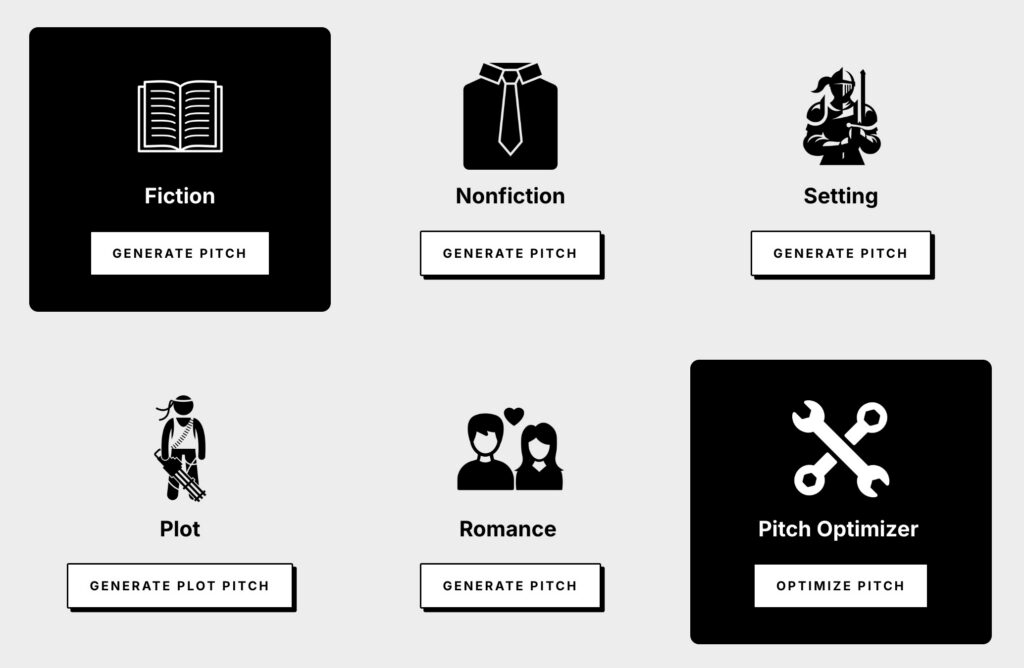
I also have a tool called Book to Blurb, where you upload your book, it reads it, and writes the pitches. The other tools are actually more valuable, though. They’re more work because you have to answer some hard questions about your own story. But they get you thinking correctly about your book in a way that an AI summary doesn’t. If you have access to the Patron Toolbox, you have access to all of those.
Steve: Having that blank page problem with your pitch is so common. I talk to authors at writers conferences and say, “So what’s your book about?” and they start fumbling. A lot of it is nerves, I understand that. But they haven’t really thought through how to describe it. Those are the moments where having prepared your pitch well in advance makes all the difference.
Closing Pitch: What is Sacred Margins about?
Thomas: Steve, give us the 25-word pitch for why we have to buy Sacred Margins today and start reading it tomorrow.
Steve: Every writer writes from a well of water, and if your well is dry, the output is dry as well. The nature of the spiritual life is to build that well and make it deep and to have a way that it can continually be filled. That’s what I try to express in this book.
When I was first asked to teach on the spiritual life of the writer, I asked the conference director, “Me? Why me?” He said, “You’re kind of like a pastor to writers.” I went, “Really? All I do is tell people no.” He said, “Well, you tell people the truth.”
And I started thinking about it and realized I had spent my entire life reading books on the deeper life, exploring Scripture, digging into what God had for me. I was like a reservoir. And I realized I needed to build an aqueduct to move the water to where the people were thirsty. That metaphor is what carried me and what inspired me to write this book.
Thomas: Dig your well before you’re thirsty. Buy Sacred Margins now.
Steve: That’s a better pitch than mine.
Thomas has built some remarkable tools that I don’t think are well-known beyond the community he’s built. More people need to be patrons and have access to some of these tools. Half of them may not be useful to you, but one of them may be a real game-changer, and these are not things you’re going to find anywhere else.
And one final word: take a look at your schedule. Find a writers conference in your region. Carve out the time and go build a network of fellow writers. Or join something like Becky Antkowiak’s 540, a free group of thousands of writers who gather and share in community. Don’t go this alone.
The fact that over 400 of you registered for this webinar still amazes me. I appreciate the opportunity Thomas gave me to talk with you all about the book and about this industry. We’re in the world-changing business.
Thomas: One of the places where I learned a lot of my early insights on publishing was at Mount Hermon Writers Conference. After about 10:00 PM, Steve would camp out at the coffee shop and just tell war stories about all the crazy things he had seen in this industry. It’s genuinely valuable. If you don’t subscribe to Steve’s blog, make sure you sign up. He shares new stories every Monday.
Watch the webinar replay.