
The apostle Paul begged God three times to remove his thorn in the flesh, and God said no all three times. Then God said something that changes everything for writers who struggle with chronic illness. God told Paul, “My grace is sufficient for you, for my power is made perfect in weakness.”
That’s a beautiful verse to have cross-stitched on a pillow. It’s a much harder verse to live by when you’re puking into the toilet while a manuscript deadline looms over your head, and some of you know exactly what that’s like.
Many authors are eventually forced to ask, “How do I keep writing when my body is actively working against me?” For some it’s a bad week or a bad month, but for some it’s a condition unlikely to ever go away. That kind of health challenge redefines what a productive writing day even means. If you hear somebody talk about writing 20,000 words in an intense eight-hour session, you might think, “I’ve never had an intense eight-hour work session this decade.”
So how do you write with a chronic health challenge?
Which came first, the writing or the pain?
Thomas: Tell us your story. Which started first, the writing or the pain?
Glenna: Good question. I’ve been a writer since I was a small child. My parents gave me a journal when I was eight, and I remember thinking this was the greatest thing that had ever happened to me because I could write down everything in my head and hide it where no one could ever see it.
That led to chronicling my entire life from that moment forward. I took creative writing classes in high school, loved them, and got a degree in creative writing in college. Then I was a secret blogger for a long time and didn’t pursue publishing until I was in my thirties.
So writing came first. It’s always been the thing I was going to do no matter what. Published or not, writing was the fabric of my life. It’s the way I process my life.
My chronic pain started when I was in my late twenties. I just turned 45, so you can do the math. There wasn’t an injury that caused it. It just happened.
Looking back, I know it started after a really difficult season of stress. My husband is a pastor, and we were going through a hard time in our church, with stress upon stress upon stress. These symptoms started waking up, and they didn’t seem connected at the time. I spent six years chasing a diagnosis, and once I had it, everything made sense.
Finding a treatment that worked took almost another decade.
That season of trials in our ministry life is what triggered it. I have an autoimmune disease, and this is what autoimmune disease does. You can have a genetic predisposition, which I do. Stress triggers it into activity, and that’s exactly what happened to me. Even though that season of life came to an end, I’ll deal with the ramifications of the disease for the rest of my life.
I always live in a flare, and then I have flares within flares where it’s particularly bad, and I have trouble walking or doing normal things. Any new stress will trigger the disease into even more activity.
My body thinks it’s attacking a bacteria or a virus, but it’s actually attacking a gene that lives in my spine, my hips, a lot of my connective tissue, behind my eyes, and my rib cage. It’s super futile when you think about it. It’s real evidence of the fall.
Thomas: Autoimmune issues have exploded in prevalence around the country. I struggle with some autoimmune issues myself. For me, the fix ended up being massive amounts of dietary fiber, and I’m a new person now.
But you’re dealing with intense pain with no end in sight, and you’re a writer from an early age. How did you continue to publish books through all that?
How do you keep writing when your body is working against you?
Glenna: There are seasons where my pain is more manageable than others, and for a lot of my book contracts I was able to get through at a fairly normal pace. But I have a couple of books I particularly remember writing under contract. I wrote a book on scripture memorization mostly from bed and the couch. I had a lot of GI issues too, which isn’t unusual with autoimmune disease, and I lost 20 pounds that spring. I couldn’t eat, couldn’t keep anything down.
One of the things that comes with autoimmune disease is brain fog, so you have days you just can’t think straight. My approach is to take advantage of good days and write as much as I can. I have a pretty type-A and structured schedule. For my writing schedule, I have admin days, article days, and book writing days where I don’t do anything else. If I’m under contract, I schedule one or two writing days a week, and I schedule in enough buffer in case something goes wrong with my body.
If I’ve got a six-month book contract, I start working at a pace that gives me a six-week buffer before the deadline. That’s helped me the most, because for nearly every book I’ve written, there’s been a season where I’ve had to take a few weeks off, either because my brain isn’t firing on all cylinders or because I physically can’t sit at the table to write.
Lately I’ve had a lot of problems with my hands, so typing has been a challenge. Scheduling in a buffer has been the most helpful thing.
And sometimes you just write while you don’t feel good because the deadline trumps everything.
Do you ever feel guilty about the lost weeks?
Thomas: Do you ever feel guilty during a sick window where you can’t do anything for a couple of weeks?
Glenna: I do, and I feel anxious because I’m always afraid I won’t finish in time. I’m one of those people who if I don’t turn something in early, it’s late. That’s why I give myself that buffer. I hate having to take a break when my brain is really churning through a chapter. But I’m a human person with limitations, so sometimes I just have to.
Thomas: When I was dealing with my chronic issues, I spent a lot of time in bed with really low energy. It felt like I had enough energy for one thing a day.
I used to do paid consultation calls, and after an hour-long call, I’d be done for the rest of the day. One thing I found helpful was putting that in-bed time to good use by listening to podcasts and audiobooks. My bed became a classroom instead of a couch for watching Netflix. I read over 100 books some years because I literally couldn’t do anything else.
Just because you have brain fog doesn’t mean you can’t do anything, but there are certain things you can only do during your healthy windows.
One challenge for me was giving my whole healthy window away to email, because there’s no end to email, and I like to keep my inbox at zero. I can do email at low-energy or high-energy times, so disciplining myself not to do it during high-energy time was something I never really mastered. It’s one thing to listen to audiobooks in bed because that’s the only thing you can do. It’s harder to say, “I’m not going to check email first thing. I’m going to write first thing.”
Glenna: I’ve dealt with a lot of migraines the last couple of years, and I can’t even look at a screen when I have a migraine. This spring I burned out on email and social media and just shut a lot of it down, because it was stealing my writing time. But email is how I communicate. I’m also a speaker, so there’s a lot of back and forth setting up events.
One day I sent an email without realizing I was in the early stages of a migraine. The next day I pulled it up, and it was gibberish, filled with words that weren’t words. I had to send a follow-up saying, “Sorry about that. My brain was not functioning.”
What you said about giving your healthy margin to things you can do while tired is a really good point. That’s why I try to reserve writing days for when I feel good. I’ll turn on “do not disturb” and write as much as I can while I feel well, because if I’m exhausted afterward, at least I put that energy toward something that’s going to last.
How do you protect your best hours?
Thomas: It helps to know your rhythms. Some people know they’ll feel bad after lunch. That was me. I was following vague nutrition guidelines that weren’t working, so I felt sick after lunch.
Back when I was really sick, lunch would wipe me out, partly because I wasn’t digesting food well since I wasn’t eating fiber. When I was being strategic, I’d save my email for that low-energy window after lunch, then use my recovered energy for bigger priorities. Then I got married and had children, and my family didn’t appreciate my energy surge happening right at five or six in the evening.
Glenna: That’s the witching hour. The worst possible time to be working.
Thomas: The little barbarians are at the gates with their pitchforks, wanting you to play with them or hear about their day.
Some people don’t have rhythms at all. They just have unpredictable flare-ups. I know what that’s like with migraines too. I’ve had to do live webinars mid-migraine.
We used to run a big course called Book Launch Blueprint, and I’d get stress migraines every single time, doing two-hour Q&As while fighting for my life. We don’t run that course anymore. Lessons were learned, and one of them was to keep things smaller and more strategic.
What is Spoon Theory?
Thomas: You’ve talked about something called Spoon Theory, a way of navigating good days and bad days. Walk us through it.
Glenna: In my book, I quoted Christine Miserandino, who used spoons to create a metaphor for energy. She’s sitting with a friend at a diner trying to explain that, as a person with lupus, she doesn’t get the same amount of energy as a healthy person. She grabs a fistful of spoons from the counter and gives her friend and herself the same number of spoons. She explains that it takes a healthy person one spoon to get ready for work, eat breakfast, and commute. It takes her a spoon just to get out of bed, another to shower, another for medication that makes her sick to her stomach, and another to get to work. By the time she’s at work, she might have two spoons left for the rest of the day.
A healthy person can push through, and their spoons replenish, or they can borrow one. A person who isn’t well spends spoons faster, and they don’t regenerate at the same rate. That’s helpful for explaining to a healthy person that things that are easy for them require far more energy from you, and then you have to recover from it.
I travel and speak a lot, and I limit how much I do because I know what my body can handle. I have to cushion my trips with days off before and after, or I’ll slide right into a weeks-long flare and be no good to anyone. Some things just aren’t worth spending a spoon, so you don’t do them.
Thomas: Stephen Covey would say to put the big rocks in the jar first, before the sand or water, or you can’t fit them in.
That tip about scheduling buffer days goes back to knowing your rhythms. If you know you’re tired after lunch, schedule around it. If you know you’re wiped out after traveling, schedule around that too. I
had a standing all-day appointment with myself called recovery, usually the Monday and Tuesday after a conference, because if I wasn’t careful, the first day I was available for calls would fill up completely. If that landed on a Monday when I was still wiped out, not just physically from travel but from the mental toll of constantly being “on,” it made things worse.
I’m not the most extroverted person, and a conference wipes me out. Giving myself permission to recover matters. What I still struggle with is scheduling the things that actually rejuvenate me, like taking my kids on a walk in the woods. Sometimes I’ll be physically fatigued and think, “Am I really going to spend two spoons driving to the woods when I could walk in my neighborhood?” But walking in the woods is more rejuvenating than walking through my politically charged neighborhood where everyone’s flying flags at each other. The woods win.
What practical tools help when you’re barely functioning?
Thomas: I have some other tips for authors who are struggling, and I’m curious what you think of them.
Tip #1: AirPods. AirPods were really helpful for me for listening to audiobooks and podcasts in bed. They’re Apple’s wireless earbuds, and if AirPods were their own business, they’d be one of the 10 biggest businesses in the world.
They also allow you to dictate, which isn’t something I did much of, since I’m more of a podcaster than an author, but I’ve talked to so many people with chronic energy or autoimmune issues, and also people who’ve written their wrists into the ground, for whom dictation is essentially mandatory if they want to keep writing.
I want to put people at ease who feel like dictation isn’t real writing, because if it was good enough for the apostle Paul, it’s good enough for the rest of us. We know Paul dictated the book of Romans from Romans 16 itself. Nobody reads Romans 16 because it’s mostly greetings, but in it, the man Paul dictated to sends his own greetings too. So don’t listen to anyone who says real writing has to be done with a typewriter or a ballpoint pen, or that cleaning up dictation with AI doesn’t count.
AirPods let you dictate while walking or lying on your back. You may just need to rest your mind. If you’ve got a migraine and you’re writing gibberish, AI can’t fix that. Of all the health issues I’ve faced, migraines were the most bewildering, because they didn’t cause physical pain so much as made me stupid. It was strange feeling to be stupid when I knew I could normally do the thing in front of me.
Glenna: My email looked like I was writing in tongues.
Thomas: Going easy on yourself matters, and so does learning to say no.
One of my frustrations was that my health issues were vague and undiagnosed for a long time. I was just sick with no clear diagnosis. Early on, I remember being angry and thinking, “God, why couldn’t I just have cancer?” Because if you can name it, people treat you differently. They’re understanding, and there are support networks. I
don’t often feel God speaking to me, but I really felt Him say, “Thomas, what do you deserve?”
I said, “Hell.”
And He said, “That’s right. Stop complaining.”
It was a firm, “Sit up, stop whining,” and sometimes that’s exactly the kick in the pants we need.
It’s very easy to let a sickness become your identity, and once it’s your identity, it becomes your excuse, and suddenly you’re not writing anymore because you have chronic issues.
Now, for some people the rules are different. I’ve had people come into our community who’ve been given six months to live and want to get a book out before they die. For that author, hybrid publishing is worth considering, because building a platform the slow way doesn’t apply anymore.
Most of us aren’t in that position. Most of us have whatever’s in the air, the water, the soil, and the food that’s giving everybody chronic health issues, and it’s really common for millions of us. Not letting it become our identity matters, and so does holding onto hope that it won’t necessarily last forever.
Is your diagnosis allowed to become your identity?
Glenna: The way the doctor worded it when I was finally diagnosed was, “You won’t die from it, but you’ll die with it.” I had to look at the rest of my life and say, “It can’t be my whole life, even though it’s a factor that affects how I live the rest of my life.”
For years before I found a treatment that helped, my whole life revolved around mitigating pain. I’d fall asleep immediately, wake up two hours later gripped with pain, move to the couch, ice and heat, try to sleep sitting up, or just walk the floors all night. I have axial spondylitis and psoriatic arthritis, two diseases in the family of inflammatory arthritis, and lying flat was impossible. Nights were always worse because of that. During the day I did okay besides the extreme fatigue and brain fog, and then the cycle would start over every night. It wore me down.
Balancing mitigating pain, living your life around this thing that eats up all your energy, and not letting it define you is a hard line to walk.
My husband doesn’t have the mercy gene, and he was always quick to remind me, “This is what you have; it’s not who you are.” He’s a type 1 diabetic and has been since he was 11, and he doesn’t live life defined by that disease either, so he’s a good example to me. I’ve known people who define their whole life by their illness, and they miss so much, including the fact that in Christ, this isn’t the only body we’ll ever have.
Thomas: We live in a world that rewards victims, and it’s easy to seek victim status so people go easy on you.
Glenna: That victim mindset is bad for your character and your heart, because your whole world becomes about you. That’s not the Christian life, and there’s so much in Scripture about how to endure suffering that isn’t about that.
Thomas: Suffering is a tool God uses to build character.
As I’ve gotten healthier, I’ve started purposefully embracing suffering. I go to the gym to suffer, and it’s the same principle in weight training. The muscles have to damage themselves a little to rebuild bigger.
Did you ever consider opioids?
Glenna: No one ever recommended them, I think because it wouldn’t work long term. I’ve had surgeries, including one on my left hand in December that hasn’t healed well, so I’m scared to get the other one done. I had to take heavy drugs for the bone surgery, and I can’t think clearly on those. That was never going to be a long-term option for me. I had to heal from surgery, and I got off those drugs as fast as I could, because I don’t like not being in control of my mind.
What practical tools help when you’re barely functioning?
Tip #2: Work on one thing at a time.
If you’re dealing with brain fog or fatigue, switching tasks costs you a spoon. You’ll hear people say they write in the morning and do marketing in the afternoon, but that may not work for you. One switch a day might be fine, but doing email, then writing, then marketing, then education in the same day is too much switching. The more you focus, the more you optimize your limited energy. This is a pro tip for everyone, but when you have limited energy, you’re forced to be strategic about what you spend your time on.
Glenna: Having certain tasks scheduled on certain days really alleviates that for me. I don’t switch well, and trying to move between projects in the same day is too much, especially with any brain fog.
Book writing needs a long runway in and a long runway out. Other things, like working on my newsletter, are more like a helicopter. You can lift up and set back down without much mental load, so I schedule those little helicopter activities on days I can handle that kind of switching. If you ask me to do a marketing day and a book-writing day on the same day, I’ll crash.
It takes self-awareness to know what you can and can’t do.
Thomas: For me, it meant moving away from the to-do list altogether. I used to keep a rigid list on paper and copy unfinished items to the next page.
I moved to using Google Calendar for everything. When I decided something needed to happen, I also had to decide when, so it went on the calendar, which signaled to future me what I needed to do.
Fatigue can be an occasion for sin, since laziness is one of the deadly sins, and it takes wisdom to tell whether you’re resting so your body can heal or using fatigue as an excuse to be lazy. Those can look identical. We’re told in 2 Corinthians 5:10 that we must all appear before the judgment seat of Christ, so that each of us may receive what is due us for the things done while in the body, whether good or bad.” Giving an account for what I’ve done is a sobering thought.
I also found that planning itself requires its own spoon. When I’m mentally fatigued, just deciding what to work on is exhausting. My income comes from a dozen different places rather than one thing. Using the calendar helps, and it lets me use tools like Calendly without it messing up my day, because my tasks are already blocked off.
Glenna: Time blocking helps me too. I use a different color for different kinds of writing, so this interview is pink on my calendar, and I know not to schedule certain colors on the same day because that breaks my brain.
I’m very type A and scheduled, and I’ll turn things in early rather than make people wait, which can mean I’m working when I should be resting. One thing I’ve tried to do better this year is guard my Sabbath rest.
We’re a ministry family; my husband’s a pastor, and Sundays are busy from early morning to mid-afternoon. We don’t have evening services, so I guard Sunday afternoons and evenings closely. I’ll go into church with a mental list of things I could write that afternoon, and by the time we’re through church and lunch, I’m cooked, even though I have joy from being with the people of God.
So, I’ve stopped doing that. I’m not God. I’m human, embodied, and limited, and I need extra rest. I’m trying to practice napping, even though I’m a terrible sleeper with chronic insomnia on top of the pain. Even just lying there resting instead of working helps my work later in the week. For a type A person, that’s hard. In some ways it makes me almost grateful for the chronic pain, because it keeps me from running hard all the time, which we’re not meant to do. We’re created to rest.
Why does guarding your rest actually help your work?
Thomas: Hindsight lets you see the truth of God working all things together for the good of those who love Him. In the moment when we’re getting sick, we’re not thinking, “This is God teaching me to focus and rest.” We’re just enduring it. But looking back, we can see a glimpse, though we still only see through the glass dimly.
In my weight training, I use an app called Hevy that schedules rest between reps, and I wondered why I needed that much rest. My health council of AI models I created pulled the academic research and confirmed that the rest matters even during a workout.
The Bible describes three kinds of rest. There’s daily rest, weekly Sabbath rest, and a third rest connected to judgment in the Old Testament, which is the one-in-seven-years rest.
In Leviticus, God commands the Israelites not to plant their fields one year in seven. We now know the agricultural benefits, but there’s also a spiritual benefit connected to the sin of anxiety, which Jesus places right alongside lust as a sin rooted in a lack of faith. Not planting the fields you rely on to eat requires real faith, and God promised that in the sixth year the harvest would be so abundant it would carry them through.
That promise came with a judgment attached too. The length of Israel’s exile matched the number of Sabbath years they had skipped.
Sometimes when I get sick, it feels like a smaller version of that, God saying, “You didn’t rest, so now you will.”
Glenna: That’s really interesting. I have two close friends we talk with almost daily on the Marco Polo app. None of us live in the same state. One is recovering from a major operation after a lot of pain leading up to it, another is undergoing chemo for colon cancer, and then there’s me with my ongoing health issues. This year we’ve talked nonstop about forced rest, since we’re all in ministry too. If we refuse to submit to God’s plan for our bodies, brains, and worship, sometimes rest gets forced on us whether we want it or not.
When you’re flat in bed with a migraine, the whole to-do list goes out the window. I get ocular migraines and lose my vision for a while, and all you can do is lie there and endure it.
Sometimes I think the Lord is refining my faith and also teaching me that I’m not God. I’m not omniscient or all-powerful. I’m just me, and I need to rest and trust the Lord with my life.
Thomas: That trust is the hard part, especially as a driven person who feels like their value comes from their work, especially if you’re a breadwinner. Trusting that God is ultimately the provider, that He works through me but doesn’t need to, is genuinely challenging, especially watching what feels like a lot of instability in the world right now.
Part of the motivation to keep going to the gym or eating well is that I can’t fix the bigger things I can see happening in the world, but God can. He’s brought civilizations through collapse before for His own purposes.
Glenna: That’s right, and His gospel still prevails.
How has prayer been part of your writing and pain?
Thomas: I want to talk about prayer, since you literally wrote a book called Praying in Pain. We’ve been very practical about mitigating chronic pain, but I want you to speak to the person who’s been in bed for three weeks and feels like so little of this can be put into practice.
At some point they have to come out of bed and sit at a computer, and they may be giving up hope that will ever happen.
Glenna: You can pray, and you can pray in bed, from the couch, from a magnesium bath, or walking if you’re able.
What I love about God’s Word is that He gave us the lament Psalms as a way to pray when we don’t know what to pray. In my nice Southern upbringing, you weren’t supposed to complain about anything to anyone, especially not the Lord. A lament starts with a complaint, but the difference is you’re not complaining about God; you’re complaining to Him.
Lament psalms typically follow a pattern that gives you space to biblically complain about your condition. Psalm 13 asks, “How long, O Lord? Will You forget me forever?” That’s real, deep grief, thinking the Lord has forgotten you. Then they turn a corner toward a panicked cry for help, because where else would you go when you’re lying in bed and you’ve tried every treatment, or you can’t even get in to see the doctor for another six months?
You can and should ask God to heal you. He still does sometimes. He healed my dad’s cancer last year. I’ve seen God heal, and I’ve also seen Him not heal. I still have pretty severe chronic pain, and I use an immunosuppressant that’s a real gift, since it’s restored some quality of life. But I’ll deal with pain for the rest of my life. I still ask the Lord to heal me sometimes. My church faithfully prays for my healing, and when I don’t have the words, they pray for me.
We should also ask God to carry us. “Lord, if You aren’t going to heal me, help me endure. Give me what I need.” We can pray that with confidence, because He always does.
The lament psalms almost always take another turn, stopping to reflect on God’s past faithfulness. For Israel, that meant remembering their deliverance from slavery in Egypt, which was the biggest story of the redemptive arc until Christ came. They’d rehearse what God had done and resolve to trust He would carry them through the rest of their suffering, whether exile or hardship.
Ultimately we’re looking for the deliverance that comes when Christ returns, and we receive resurrected bodies that will never hurt again.
When you look at how New Testament writers encourage perseverance in suffering, they always tie it to the promise of Christ’s return. Endure, be faithful, persevere, because He’s coming. When you have a chronic pain issue, it’s easy to feel rooted entirely in the here and now, but this life is a blip against the scale of eternity with Christ.
So when you’re lying in bed and can’t write, can’t dictate, can’t even think straight, you can pray. You can listen to the psalms read aloud, and pray them back to the Lord, not because He needs reminding of what’s true, but because we do. I’ve found that immensely helpful when I can do nothing else. Prayer is never nothing.
Thomas: Pray out loud. There’s something powerful about that. I don’t understand the spiritual world particularly well, but I know there’s life and death in the power of the tongue, and praying out loud does something more than praying silently.
There is also hope. I heard a sermon illustration once that our resurrected bodies will probably feel like clothes fresh out of the dryer, that warm feeling that fades the moment you put them on. Our new bodies will be redeemed and restored permanently.
There are certain human emotions that I think God knew we would feel guilty about having, so He created whole books of the Bible about those emotions to force us to acknowledge the fact that they’re okay to have.
One of them is sexual arousal. He gave us the entire book of Song of Solomon, which is a long sex scene between a husband and wife. And every time you read through the Bible, you’ll have to acknowledge that the feeling is okay.
The other one is lament. God gave us the lament psalms as well as the whole book of Lamentations, which is just mourning.
Why does the church need to bring back the casserole?
Glenna: For a long time in American church culture, it hasn’t been “appropriate” to talk about hard things. Years ago I shared a testimony about our history of infertility, and afterward an older woman told me I shouldn’t talk about that, that I felt too much and it wasn’t appropriate to share. I remember thinking, “Tell that to David.”
Her generation practiced a kind of bootstrap theology where you were always fine. You didn’t burden the church with your troubles. But one reason God gave us the church was so believers could help carry each other’s burdens, and we can’t obey that command if we don’t know what the burden is.
You should make your needs known to the Lord. His shoulders can handle it.
Thomas: Your physical challenge is a metaphor for this too. When one part of the body hurts, the whole body hurts. Your immune system attacks one gene, but the pain is everywhere.
What heals the body is the body itself. The surgeon doesn’t heal you, and the medicine doesn’t heal you. They aid the body in healing itself, cells growing new cells, cells fighting off viruses. If you don’t share what you’re carrying with your brothers and sisters in Christ, they can’t bring that healing, and you’re potentially robbing them of the blessing of showing up for you. There’s a fading practice we need to bring back of making a casserole for someone who’s sick.
Glenna: I’m in a church where if you have surgery or get sick, they’ll feed you until you’re sick again. An army will bring you casseroles, and I’m so thankful for it. James 5 says if anyone is sick, they should call the elders to pray and anoint them with oil. I think the casserole is the natural outflow of that prayer. I have hungry boys, and my church takes care of them when I’m having a bad time.
Thomas: It’s not about the calories or the money, since you could order a pizza.
Glenna: I could, but it’s not the same as a church member knocking on my door with dinner and sitting down to pray with me.
Thomas: One of our church leaders makes an 18-hour Texas brisket, the real slow way, when someone’s sick. He could have bought equally good brisket in town, but it meant something because he made it himself and prayed with us. We felt loved and included.
Sometimes we don’t know what to pray. There’s a meme that was going around recently that features a picture of the food critic from Ratatouille with the caption, “I don’t manifest. I don’t wish. I don’t channel energy. I don’t trust in the universe. I pray, and if God doesn’t give me what I pray for, then I don’t need it.” That’s the difference between how God operates and the old folklore idea that you have to word a wish carefully or a trickster spirit will hold you to the letter of it.
God knows what we actually need, and sometimes withholding what we ask for is an act of love. Someone might pray for their book to be a bestseller, and God’s mercy is that it doesn’t happen, because they can’t yet handle that level of fame without it corrupting them.
We don’t see the whole chessboard. We see only the square we’re on and maybe a few nearby. But we have a God who is powerful, merciful, and compassionate, who was tested in all things and suffered as a man of sorrows. He knows what it is to suffer in the body. One of the lament psalms says, “I can count all my bones,” and that’s the one Jesus quoted from the cross, not because God had forsaken Him, but because that was the only line He could get out while gasping for breath, since crucifixion kills by denying you air. He wasn’t quoting long passages. He was gasping out a single line.
God is with us in our suffering. Our sin doesn’t scare Him off, and neither does our suffering. He may be tough on us sometimes, the way He was tough on me, the way I’m sometimes tough on my own kids or on myself in the gym, but that toughness isn’t cruelty. Suffering itself isn’t evil. It can be an occasion for bitterness or anxiety, but it can also be an occasion for grace and growth in Christ.
Glenna: Absolutely. First Peter says genuine faith is refined through suffering, and we shouldn’t act surprised by it, as if something strange were happening to us. We’re sharing in Christ’s sufferings, and no one knows suffering like Jesus. It’s often the very thing we try hardest to escape, and yet it’s often what God uses to make us most like Him.
God won’t always heal us this side of heaven, but we can be sure of healing in heaven if not in this life.
The greater encouragement is that Jesus advocates for us in prayer. He’s seated at the Father’s right hand, interceding for us, and the Holy Spirit takes our prayers and makes them better when we don’t know how to pray or feel like we’re getting it all wrong. The Father loves us with the same love He has for Jesus, according to John 15, so He hears our prayers.
If you can’t do anything else, if you can’t write or think clearly, you can pray, and the Lord hears you.
Thomas: That prayer may be exactly what you need to improve your writing as a Christian author.
Glenna: So true. That trial you’re enduring could be great book content down the road.
Thomas: Ray Comfort has a line about praying as a young Christian for a life that would lead to good sermon illustrations.
Glenna: I don’t know that you should pray that.
Thomas: God gave him that life anyway, in His kindness and sovereignty.
Glenna: Ultimately He’s a good God who’s trustworthy, and we do have to keep reminding ourselves of that.
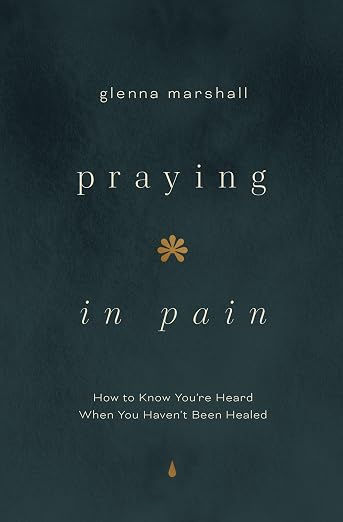
What is Praying in Pain about?
Thomas: Tell us about your book, Praying in Pain. I feel like it might be exactly what some listeners need right now.
Glenna: I wrote what I call the Sufferer’s Lament, a short lament prayer for people who struggle with chronic pain. Then, I wrote the book so that each line of the prayer has its own chapter. We talk through what it means to pray a lament, and really the book is a theology of physical suffering. Why does God allow it? Why won’t He heal it? Why the thorn in the flesh? We talk about Paul’s prayer and the Lord’s three no’s, and what that says about how God feels about you, and whether He’s okay with you hurting.
I wanted to write the resource I needed 16 years ago, something that says, “I know you deal with chronic pain, and I hope this book is a balm and a comfort, a warm blanket right out of the dryer that helps you know how to endure.” I wrote it with a lot of love for people who suffer, and a lot of tears.
Praying in Pain is the book I needed, and that’s what writers do. We write the book we needed. I hope it’s a great comfort to people.
Connect with Glenna Marshall
- Website: GlennaMarshall.com
- Book: Praying in Pain: How to Know You’re Heard When You Haven’t Been Healed (affiliate link)