
Think about how long you’ve been working on your novel. How long has it been since the story first took root in your head?
Many writers have been working on their book for years.
You’ve started, stopped, and restarted with a fresh Scrivener file or a fresh Word document, telling yourself you’ll finish this summer, or during NaNoWriMo. Meanwhile, you listen to authors like Jerry Jenkins, who publishes multiple books a year, and wonder how he does it.
Learning to write faster is not a shortcut. It’s the actual skill. Most authors need to write five or six books before they can produce one that is commercially viable, which is why you shouldn’t publish your first book first. Most authors need to write several books before publishing one.
Write a book every 60 days, and you could finish half a dozen books in a year rather than spending a lifetime on one.
But how do you write a book in 60 days? I asked Colleen Mitchell, a writing coach and host of the Novel Writing Podcast, who spent years running the 60-Day Novel Writing Challenge, a system that has helped writers of every skill level go from blank page to finished draft.
What does “stuck” look like for most novelists?
Thomas: Many authors come to you when they’re stuck. What does stuck look like for most novelists?
Colleen: The biggest thing I’ve seen is they’re constantly rewriting chapter one. They can’t push through a saggy middle, and most often they never reach the end. They never get to the point where they can say, “I wrote the end,” and feel confident enough to do something else with the book.
Thomas: There’s something scary about finishing a book, and something safe about working on one. I see authors who love being writers and going to conferences, but they never want to take the risk of exposing themselves to criticism or rejection. You don’t have to worry about rejection if you never finish your book.
Colleen: Exactly. So many people are afraid of that exposure, of putting themselves out there where people might judge them. But you’re not your book. The work is not you. Ship it and let it grow up.
Thomas: Or at least finish it. Many authors keep rewriting the beginning because they know it’s not very good and think that rewriting it again is how it gets better. The real way to get better is to finish the book, then write the next one.
Why shouldn’t you publish your first book first?
Thomas: It’s not that the first book you write won’t get published. The commandment isn’t “Thou shalt not publish thine first book.” It’s “Thou shalt not publish thine first book first.” Once you’ve published something else, you’ll have the eyes to see your first book clearly and know what needs fixing.
Brandon Sanderson published 20 or 30 books before he published the first one he wrote, and even then, he released it more as a novelty than as something meant for readers. It’s called Way of Kings Prime, and I don’t think you can even buy it on Amazon. It was a Kickstarter perk.
Many mega bestsellers become mega bestsellers because their authors had the discipline to write in obscurity and finish in obscurity first, and they learned to write quickly along the way.
Keeping a book from being published isn’t nearly as painful when it took only 60 days to write. But if it took six years, you feel like you owe it to yourself to publish it, even when it isn’t very good.
Colleen: Even if you do publish your first book, chapter one will probably change dutinh the editing process, even after a 60-day draft.
I had a friend and client who spent over a year trying to perfect her first chapter, then scrapped the whole thing once she got into the rest of the book and realized it didn’t work anymore.
Thomas: I’ve seen this many times. Often you find you’re starting the book in the wrong place. Maybe that first chapter is strong, but if the rest of the book isn’t at the same level, readers will abandon it midway, and the series is doomed.
A common mistake is making the first book you ever write the first book in a series, so your freshman effort becomes the gate every reader has to pass through to reach your better, more mature writing.
Another common mistake is feeling obligated to put every good idea you’ve ever had into that first book. You spend six years on a 200,000-word tome that’s a mess and a hassle to edit. Take a hammer to that book and shatter it into shards because every shard could be its own successful novel.
Colleen: Unused ideas can be recycled later for something else.
Thomas: So you’re practicing brainstorming, generating ideas that are separated from you so you can judge them later instead of feeling obligated to use them.
How do you get writers unstuck with the 60-day challenge?
Colleen: The first 30 days are planning and outlining. My friend Haley broke it into 30 days of homework to prep your outline, then 30 days of actual writing, so it’s a lot like NaNoWriMo, with a goal of 50,000 words. That’s 1,667 words a day.
During the outlining phase, we start by making a list of notes and ideas. Every day for 15 days, you write 10 notes and ideas, so by the end you have 150 ideas to play with. You don’t have to use all of them, but having that huge list gives you a solid starting point.
Thomas: And it gives you permission not to use all of those ideas. If you’re coming up with ideas as you’re writing the book, you feel obligated to use them.
Colleen: There are also daily focuses:
- character worksheets
- character relationships
- world building
- setting
- conflict ideas
- ways to show emotion, fights, suspense, and tension
Those are elements you don’t tend to think about when outlining a book without a process, and they make it a much stronger book once you get into the actual writing phase.
Thomas: This isn’t outlining yet; it’s preparing. You haven’t created a plot structure or started telling the story; you’re building the world and the characters. This kind of preparation is more reminiscent of how books were written back when paper and editing was expensive. Back then, writers put maximum effort into the first draft.
Now people can vomit out a first draft and edit indefinitely. That’s a method, but it’s not your method.
Colleen: It’s still not a totally clean draft. You’re going to have a really rough one, especially if you’re writing 50,000 words in 30 days.
How do you turn a pile of ideas into an outline?
Colleen: You order the ideas into an outline. The nice thing about the 60-Day Challenge, which you can get for free on my friend Haley’s YouTube channel, is that it’s structure agnostic. Whether you like Save the Cat by K.M. Weiland or another structure, the process just wants you to order the events from your notes and ideas list into something that makes sense from start to finish.
You reorder your notes and ideas into scenes and events until reading it top to bottom actually sounds like a story. It’s a very Scrivener-friendly method. The 60-Day Challenge videos show Haley using Scrivener for it.
Thomas: If you’re still writing in Microsoft Word, do yourself a favor and use literally any other book writing tool.
Many authors like Scrivener because of its index card approach. You can take ideas and put them into digital index cards that grow into scenes, sections, or chapters, and nest inside each other, which makes assembling your story and making major edits much easier than cutting and pasting and hoping you don’t accidentally delete chapter three. Microsoft Word is not for drafting. Atticus is better. Scrivener is better.
What does the writing month look like?
Thomas: So we’ve finished the first 30 days. We’ve got character sketches and a brainstorm list ordered into an outline, so we start 30 days of writing, which is essentially what used to be called NaNoWriMo and is now Novel November. I have a space on AuthorMedia.social for people doing a write-a-book-in-a-month challenge. What does that look like?
Colleen: It depends on your personal goal. The challenge itself is designed around 50,000 words in 30 days, following NaNoWriMo, but you can split that word count across however many days you can commit to. Some days you can’t write at all because of a holiday or an event, so you take the extra word count and squeeze it into the other days, or shoot for a higher count early on. If you miss a day, don’t stress. You can make it up or keep going past the 30-day mark.
Thomas: I recommend reworking NaNoWriMo a little. Take Sundays off as a Sabbath break, and set a 2,000-word goal on the days you do write.
November being the month is actually good for building character, because right around the point where you want to quit, you hit Thanksgiving, one of the most physically exhausting American holidays, since it requires cooking the most complicated meal most Americans make all year, plus travel and side dishes. Having that right at the quit mark separates the writers with tenacity from the ones looking for any excuse not to write. You’ll get that excuse on Thanksgiving, then Black Friday, then Cyber Monday.
Colleen: But the point of a challenge like that is to push through those spots. November was always the worst for me, because there were so many days I really wanted to write but couldn’t, which left me with a lower word count.
Thomas: I’d recommend choosing your no-write days ahead of time, and then doing the math on how many more words you need on the other days.
Jerry Jenkins and Angela Hunt use a similar technique. They know ahead of time, based on their deadline, how much writing they need to have done by a given date, so they know if they’re ahead or behind, and they write a lot faster than 1,600 or 2,000 words a day.
I have an episode on my other podcast, Novel Marketing, about how to write 5,000 words an hour, which is actually on the low end of what’s possible once you learn how to write quickly.
Once you unlock dictation, you can write 10,000 or 20,000 words a day, and the dictation tools are much better than they used to be. I have a tool in the Patron Tool box called The Chapterizer that takes raw dictation and cleans it up. It fixes the homophones, punctuation, capitalization, and adds quotation marks around dialogue. It’s still your terrible first draft, but it’s not one big overwhelming paragraph anymore. It’s much more approachable, and many authors write much faster than they think they can once they use it.
Should you try dictation?
Colleen: I started dictation this year because of Seth Ring. I dictate into Audacity, then upload to BookScribe, which does basically what you said, fixing the quotation marks and the word errors, through Seth Ring’s platform.
Thomas: If you’re in the Apple ecosystem, there’s an app called Just Press Record. It’s $5, and it installs on your Mac, Apple Watch, and iPhone, and works with your AirPods. Press the big red button to record, and it generates the text. You can be on a walk with the dog narrating your book. For some people that extra blood flow is a key to unlocking more writing.
It takes practice, and many people reject dictation initially because it isn’t as fast as the typing they’ve been practicing for 20 or 40 years.
It’s like learning to ride a bicycle. It feels awful at first. It’s slower than walking, and your knees are skinned, but once you unlock it, a human on a bicycle is more calorie efficient per mile than almost any animal, maybe even more efficient than a car. You have to be willing to fall and skin your knee a few times while you figure it out.
Dictation is optional, though. Jerry Jenkins still sits at his computer and types the old-fashioned way. You can go fast without dictating, but dictation is cheaper and easier than it’s ever been.
Colleen: You can do both, typing and dictating, depending on the situation. I did an episode recently on what I learned dictating 70,000 words in about 38 hours. The main thing is I won’t dictate if my husband is home and awake, because it feels awkward to be word-vomiting a story that hasn’t fully formed yet and making weird faces into space. So it’s not a consistent time. When he’s home, I type instead.
Thomas: For middle-grade or children’s book authors, dictating and recording with their kids in the room while telling the story is the magic. They get a crystal-clear reaction from an audience giving real-time feedback. They say, “No, Daddy, he didn’t do that,” and it’s captured right there in the rough draft. They get their dictated draft and their first beta reader feedback at the same time.
How do you protect your flow state?
Thomas: Most people feel insecure about hearing their own voice. The key to the Chris Fox method of 5,000 words an hour is getting in the zone, or the flow state, where the world goes quiet, and you’re just telling the story.
A key ingredient of flow state is not being interrupted. This isn’t some woo-woo thing. If you’ve ever gotten really good at something, you know what being in the zone feels like. Athletes feel it, musicians feel it on stage, and authors feel it once they’ve mastered the basics.
It’s why authors hate getting interrupted, since it can take 20 minutes to an hour to get back into flow state. Some people bounce back faster. C.S. Lewis got interrupted constantly. He’d just put his quill pen back in the ink pot, deal with the interruption, and pick up right in the middle of the sentence where he left off. But he was also C.S. Lewis.
Colleen: True, but before you enter the writing phase of the 60-day challenge, make sure your space is prepared so you’re not interrupted, and have a plan to get back into flow state quickly if you are interrupted. Maybe that’s creating the mood in the room, getting a new cup of tea, or listening to a song.
Writing 1,667 words a day can still feel like a lot on top of a full-time job or a family, so the faster you can get back into flow, the better.
I’m going through the outline for my seventh book right now. I have 60,000-word outline that I dumped out over the last couple of weeks because it was living in my head rent-free. That all happened through flow state.
Thomas: Preparing that space also means negotiating with the people you share it with and getting everyone on the same team. If your kids are used to having access to you in the mornings, and you’re carving out that time to write, you can get them on your side by offering a reward. You can say, “If I hit my goal, I’ll take everyone to see that movie that just came out,” or the ninja zone, or whatever your family would enjoy.
You can structure the same thing with your spouse. Maybe you schedule a trip if you hit your goal, so everyone’s invested in you succeeding. It could be as simple as a pizza party.
Chris Fox calls this creating your tortoise enclosure, and it requires negotiation. If you get the humans on your team, they’ll run interference for you. They’ll answer the door and the phone and keep distractions away if they see your goal as their goal too.
Colleen: It’s also important to have a motivator for yourself, not just for the family. When we ran the challenge, if you met your goal, we’d send you a physical enamel winner’s pin. I still have some on my corkboard for sentimentality. That motivated many people.
Find something that’s enticing enough to you, whether it’s dinner out with your family or a book you’ve told yourself you can’t buy until you finish this one. Whatever gets you past the hump when you’re in that messy middle.
How do you get through the messy middle?
Thomas: Let’s say we’re 40 days into the challenge. We’re past the fun beginning that was more crystallized in our head, and the fog is setting in. We’re not sure what to do next, and we’re struggling to hit the writing goal. What advice do you have for the messy middle?
Colleen: Jump around. If you typically write in order, scene one, scene two, scene three, try skipping around instead. If a future scene catches your attention more than the one you’re working on, go there. It doesn’t matter what order you write the book in, as long as it gets done.
Thomas: I love that, especially if you’re using Scrivener, since you don’t have to write the book chronologically.
Another piece of advice for the messy middle is to listen to my episode on the chiastic structure, which covers how to drop a cataclysm, or peripety (the event that changes everything), into the middle of your story.
Once you learn how the chiastic structure works, you start seeing it everywhere. It’s how many books of the Bible were written, and many classic works of fiction and famous anime use it too. In my interview with James Scott Bell, he talks about his book Write Your Novel From the Middle. He essentially rediscovered the chiastic structure from first principles, without realizing the 3,000 years of literary history behind him. He brute-forced his way to the same best practice, so it’s interesting hearing it taught with entirely different vocabulary.
My chiastic structure episode is itself structured chiastically, so there’s value in listening to it twice. Once you learn to spot it in the Bible, you’ll notice how often the peripety, the turning point, is God speaking, in both the Old and New Testaments. Seminary is one of the only places in the West that actually teaches the chiastic structure. You won’t get it in an MFA program, which is unfortunate, since so many great classic works, even Goodnight Moon and The Cat in the Hat, use it. Children love chiastic structure.
Listening to that episode will show you that if you know what you’re doing, there’s no reason for the middle to be messy. It actually becomes the most interesting part of the book, not something to get through, but the thing that makes the end worth reaching.
Colleen: I didn’t know about the importance of the midpoint until after I’d already written my first books. Once you have a book under your belt and start reading craft books, you realize you need to implement the things you’ve read.
Now, for every book I write, I try to identify the midpoint upfront, so I know what I’m writing toward and from. That’s made managing the messy middle a lot easier. For people writing their first book, though, they usually have no idea yet what their midpoint will be.
Why does finishing matter more than perfecting?
Thomas: It’s more important to finish than to do a good job, especially for your first book. You change as a person after you’ve written your first book. You go out on a date with your spouse to celebrate, or take your kids out for ice cream, or if you’re single, throw a party with your friends and a board game night. After that, for the rest of your life, you’re somebody who knows how to finish a novel.
You might go back and edit it, or you might write your next novel instead. But finishing is so important. You have a word processor, and you can fix it later. There’s a quote Chase Replogle shared at the Novel Marketing Conference, and I’m not sure if it’s original to him. He said, “Nobody will read what you write. They only read what you edit.” That’s very freeing. This first draft is allowed to be bad. No one will read it, and you can fix it later. Getting it done and learning to keep going shifts you into a workmanlike mode.
Is writer’s block real?
Thomas: I don’t think writer’s block exists. I think it’s a made-up excuse for lazy, entitled writers to justify a lazy, entitled attitude. You have to die to that attitude if you want to be professional. There’s no preacher’s block. Your pastor has to give a sermon every Sunday whether he feels inspired or not. There’s no plumber’s block, no lawyer’s block. No other profession gets to say, “It’s so difficult, I can’t do it today.” It’s, “No, get to work.”
Colleen: I think that’s a consequence of the starving artist mentality. The starving artist thinks, “I’m never going to support myself with this,” which becomes an excuse not to write when they don’t feel like it.
Thomas: It’s an aristocratic view, treating writing as a hobby you don’t need to make money from and a way of passing the time as idle rich. We don’t use that term anymore; we call it retired, and there’s a whole government apparatus that lets people be idle rich in their later years, which is a historical anomaly.
There’s always been an aristocratic class that doesn’t have to work to eat, and that attitude is incompatible with being successful. The Christian version of this says, “I don’t care about the money, I just want my book to be a ministry.” That’s noble, but it’s not a ministry unless people read it, and they won’t read it unless it’s well-marketed, well-written, finished, and published. The more people you reach, the more people are ministered to. That motivation is noble, but it’s not an excuse for an entitled attitude that expects this to be easy.
In the Old Testament, the giants in the land were no excuse for not going into the land. If God has called you to go, he’s called you to fight for it. Faith means believing that what God has called you to do matters more than how you feel. Get to work. Take the Book of James, slap yourself with it, and get to work. You’ve been called to write. Write.
Colleen: My Friday night Bible study is going through James right now, so this is very apropos.
In terms of writer’s block, I agree with you that it doesn’t exist. I think what people call writer’s block is actually a perfectionism block. You want it to be perfect. You don’t want to mess up or spend time rewriting, so you end up looking at your story as “I need to write this book” instead of “I need to write the next sentence.”
Thomas: And perfectionism is just fear. It’s cowardice, really.
There’s a whole genre of author humor about how hard writing is. But I’ve got hard news: your book will never be perfect, because you’re a sinful human being who is lazy, and even if you weren’t lazy, you’d still be sinful and imperfect.
If perfection is your standard, you’re not going to meet it. “All have sinned and fallen short,” Romans 3:23 says, and your book will fall short too, but that’s no excuse not to write the next sentence.
When people talk about skill chains, the instinct is, “I need to learn more skills first.” No, you need to do more writing, because writing is what teaches you how to write.
This isn’t like medicine, where getting it wrong can kill someone, so you need years of supervised training first. Even in medicine, you eventually do medicine, and that’s how you learn it. There’s an old quote that the carpenter doesn’t just build the house; the house builds the carpenter. You get better at writing by writing, by learning to chain books together and get over yourself enough to write even when you don’t feel like it, and by learning that your feelings can be controlled by your will. That’s an old-fashioned view. The newer view says you have trauma you need to ruminate on and go to therapy for, which I think is toxic and rooted in a kind of Gnostic spirit. The old-fashioned view was that your will could control your emotions. There’s actually a term for that: self-control, which is a fruit of the Spirit.
You can control yourself.
I have this conversation with my kids often. One of my sons is a philosopher at four years old, and he’ll ask, “Why do I do bad things? I want to do good things, but I do bad things. Why?” And I tell him these are very big questions for someone who isn’t even in grade school yet, but the Apostle Paul asks the same question.
There’s an internal enemy fighting you, a fleshly desire, alongside a redeemed longing to write and glorify God through your writing. The act of writing, the act of creativity, is part of the original work we were called to do. Work itself started in the garden before the curse, and the very first work in the garden was creative. Adam invented names for creatures that didn’t have names. In the new heavens, we’ll still be creating. There will be art there too, because we saw it before the fall, so it makes sense it continues after.
We have a redeemed desire to create and honor God through it, but also a flesh that is lazy and would rather do anything but write. That is part of the curse. Denying that flesh, forcing yourself to write when you’d rather not, is itself a holy act, because your sinful nature should be denied. Your desire to eat a cookie instead of writing a book is a desire worth denying.
Colleen: Same with doom scrolling. If you get the urge to check your phone, turn it off and put it in another room. Out of sight, out of mind, always works for me.
Thomas: Your biggest enemy for writing is your phone.
People ask how other writers find so much time to write, and the answer is in their screen time app. Pull it up. It’ll tell you how many hours a day you spend on your phone, and I’ve never met an author who didn’t have enough hours there to write two books a year just by cutting back, or by redeeming that time. If you have a dictation app, put your phone in your pocket, put your Bluetooth earbuds in, and start narrating your book instead. Suddenly you’re creating stories instead of burning screen time, telling your flesh, “Not today.”
We’re called to conquer, to win, to be victorious. That’s how Jesus judges the seven churches in Revelation. He judges them, then calls them to be victorious. None of them are called to a noble defeat. Or we follow a conquering king who wins in the end.
Colleen: As you were talking, I was thinking about how every time we put down the phone and write, or set that boundary, maybe that’s part of building up rewards in heaven.
Thomas: And it doesn’t have to be a super righteous book for the rewards to count.
If your motive is, “I want to make money so I can feed my family,” that’s still a righteous motive. Paul says if you don’t care for your own family, you’re worse than an unbeliever. For some of you, the way you care for your family is by writing books and making money doing it, and that’s good.
Now, if you’re hungry and hurting for money, writing a book isn’t what you need to be doing right now. You need a job, because publishing as a financial activity follows a winner-take-all power law, and you have to be among the best to make real money at it. You get there by writing more books, faster and better, through practice, the same way you’d become a great athlete or musician. Practice, and networking, but mostly practice.
Colleen: You could do a 60-day challenge four times a year and use the gaps in between to edit, building a back list over time.
Thomas: You’ll also teach yourself that you can write more than a book a year, more than a book a quarter, more than a book a month. I’ve interviewed authors writing a book in weeks rather than months.
Colleen: The running joke with Brandon Sanderson is that he goes on vacation, sneezes, and a book comes out.
Thomas: But he doesn’t actually. He sits down and writes, disciplined, with his own version of the tortoise enclosure, sitting on the couch in the worst ergonomic position possible. I don’t know why he doesn’t have carpal tunnel yet, though I suspect eventually he will, at which point he’ll discover dictation. Some people choose dictation. Some have it chosen for them by their wrists.
What practical tips help stuck writers get unstuck?
Thomas: If someone comes to you stuck, needing more than a motivational podcast, what do you find yourself telling coaching clients?
Colleen: The biggest one is always just letting the first draft be garbage.
If you’re past the first draft and struggling with rewrites, it’s the same perfectionism problem. The first rewrite doesn’t need to be perfect either. You’ll learn something through every rewrite, but at some point you have to decide something is good enough and move on.
If you’re a pantser rather than an outliner, you’re free to pants the first 50,000 words in those 30 days, then flip the process and use the outlining tools to build your characters and flesh out your world as a tool for the rewrite.
But one of the biggest things I do for people is hand-holding, the accountability of asking what they want to work on this week or this month, then following up. It can be anything from brainstorming character arcs to fixing plot issues to word choices and sentence structure. I’ll alpha-read people’s books, and I end up giving something like a combined developmental and copy edit, since that’s how my brain works, so it’s not technically an alpha read. It’s free edits built into the cost of coaching. But really, most people just need that accountability, someone to ask how things are going.
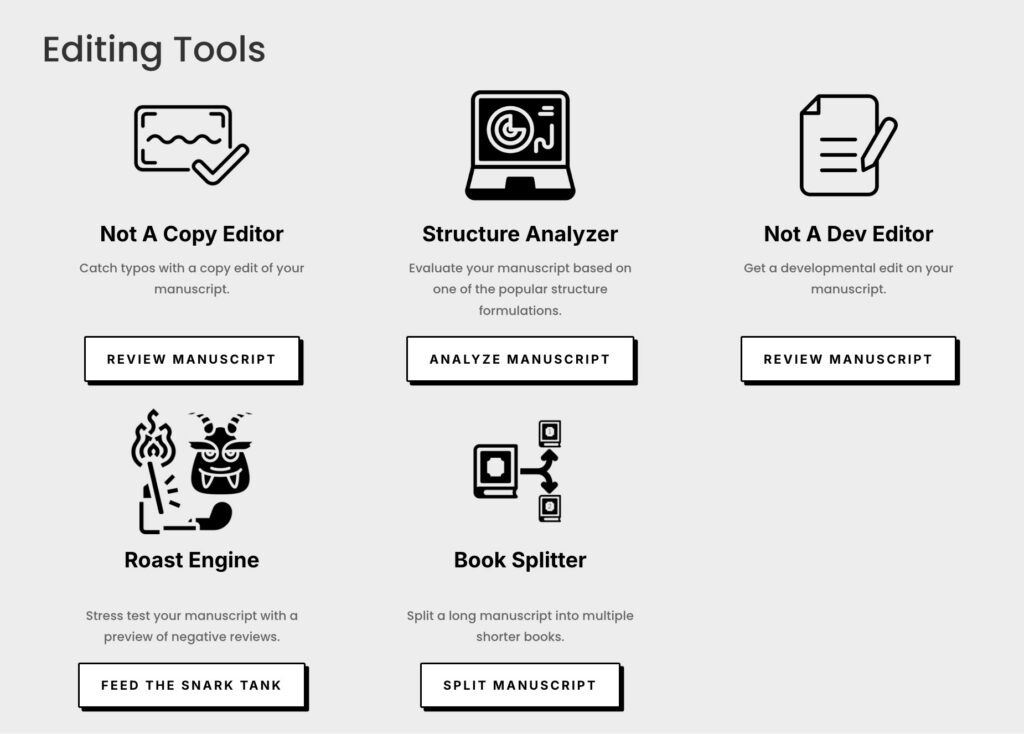
Thomas: I have a tool in the Patron Toolbox called the Structure Analyzer. Seat-of-the-pants writers love it, because they often have no idea what structure their story is in. Every author is technically an outliner; pantsers just write the world’s most detailed outline, so their first draft functions as their outline, and their second draft ends up being a near-complete rewrite, especially early in their career. As they get more advanced, their first drafts improve.
The Structure Analyzer helps you figure out which major structure your story is closest to, then gives tips on tweaking it to better fit. That’s useful after you’ve written the garbage first draft, to figure out where to make changes, because it’s not helpful for someone to just say, “This first draft is garbage.” You already know that. What you don’t know is what to do next.
I have other tools too, like the Chapter Summarizer, the Plot Synopsizer, and NOT a Developmental Editor, which isn’t a developmental editor or a replacement for a human, but gives you an initial AI-generated developmental edit, plus AI beta readers you can run your book past.
What happens in the second 30 days?
Thomas: For pantsers, the first 30 days is an intense writing sprint. What happens in the second 30 days? Is it editing or a rewrite?
Colleen: It’s more like a reverse outline. You go through what you wrote and document what exists. Then use the prompts from those first 30 days of videos to flesh it out. When you go into the rewrite, whether immediately or a few months later, you’re more prepared than if you’d just let the draft sit.
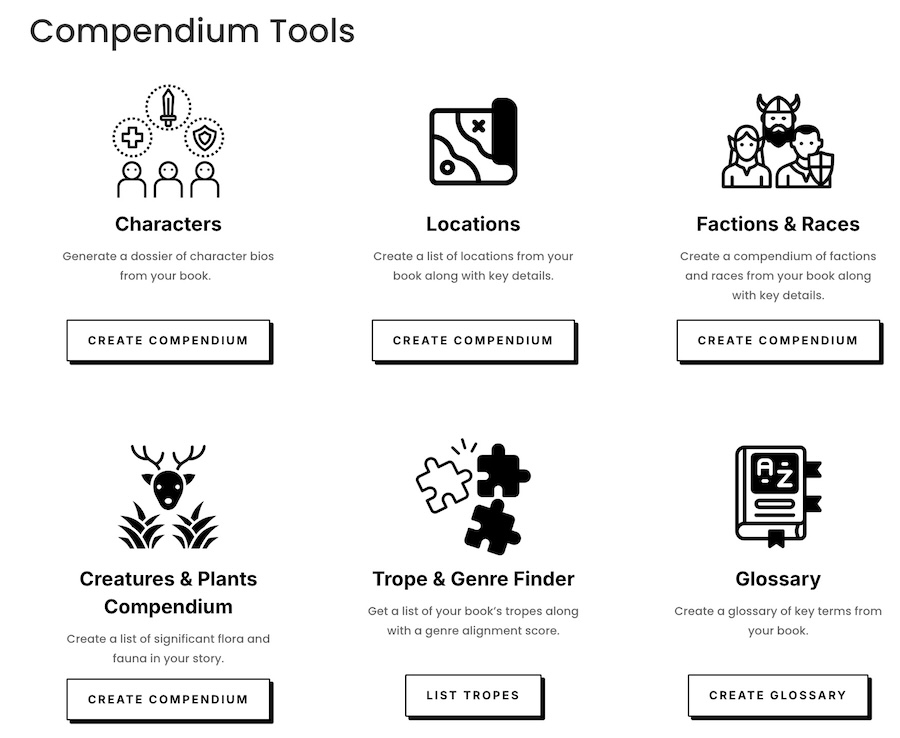
Thomas: For pantsers, I have many tools that help with that too, like a Character Compendium that creates a list of characters and each one’s arc across the draft. For fantasy writers, it’ll list all the Factions and Races, Flora and Fauna. Those compendium tools help you build outlines from your initial draft that you can then use to guide your changes. You catch things like, “Wait, that’s not the right arc, is that what I actually wrote?” and go fix it.
Can writing fast actually produce a better book?
Colleen: Compressing your writing time into 30 days means you’re less likely to lose plot threads than you would writing over multiple years. If you write it in 30 days, you’ll hopefully still remember what you wrote in the first few days by the time you connect those threads later. Write your book over three, five, or 10 years, and you won’t remember what you wrote back in chapter one by the time you reach chapter 20.
Thomas: There’s a misconception among novices that books written slowly are higher quality than books written quickly. It’s generally false, and the opposite is usually true. An author in a flow state isn’t only writing faster; they’re writing higher quality work than an author who’s slow, distracted, and taking big breaks. That kind of author generally has much slower and worse output. The overall quality of the sentences, paragraphs, and chapters tends to be lower for the slow, plotting author than for the one who gets in the zone, stays there, and produces quickly. That quick content ends up being higher quality, partly because the author still remembers what they wrote yesterday, and partly because focused work is just better work.
Do you have any final encouragement for authors?
Colleen: Just be okay with it being terrible. The whole process can feel like a drag sometimes, but if you’re passionate about the story and want to get it done, push through those 60 days to reach the point where you can say, “I finished a book,” even if it’s the crappiest words you’ve ever written. You finished a book. And once you finish it, you can do everything else it takes to get that book on a shelf.
Connect with Colleen Mitchell
- Podcast: The Novel Writing Podcast: Episodes are short and bite-sized, so binge a few to get a feel for how I talk and think. If you’re interested in coaching, there’s a link in the description of every episode to book a free intro call.
- Book: The Chronicles of Talahm
- Host of The Christian Readers Podcast